
Practice Proportional Relationships: Midline and Percent/Interest Modeling
Loading the math board and drawing, please wait…
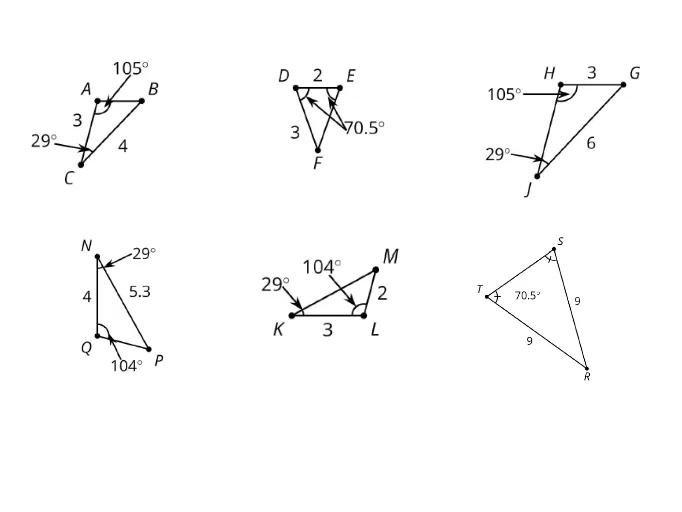
This example demonstrates how to construct and visualize proportional relationships across both geometric and numerical settings, then use the picture to support percentage and interest-style computations. The key math concepts include: proportional reasoning (capturing multiplicative relationships), the Midline Theorem (parallelism and length ratios in the triangle/cut configuration), converting percentages into equivalent scale factors, and modeling interest as a proportional increment. From the provided construction summary (objects pic1–pic6), the activity is typically arranged as several step-wise panels: first building the geometric setup where the midline property induces a ratio, then measuring/reading the corresponding proportional lengths or derived values for percentage and interest amounts, and finally comparing results across panels to reinforce the proportional interpretation. Suitable for middle school learners and review lessons on ratios, percentages, and foundational geometry properties.
AI Drawing Prompt Reference
Draw a combined geometric and numerical diagram: first, sketch a triangle with a midline parallel to its base, dividing it into a smaller triangle and a trapezoid, and label the length ratio between the midline and the base. Beside it, place a numeric panel showing percentage and interest relationships using a scale, for example, scaling a length up or down by a factor, with arrows or labels indicating the proportional factor. Arrange the layout into several sections, each displaying geometric proportion, percentage conversion, and interest increment modeling, separated by dashed lines or colors to highlight the visual comparison of proportional relationships.
The prompt above was compiled from the original drawing commands and is for reference only.