
Practice Factoring Trinomials by brettbellaire
Loading the math board and drawing, please wait…
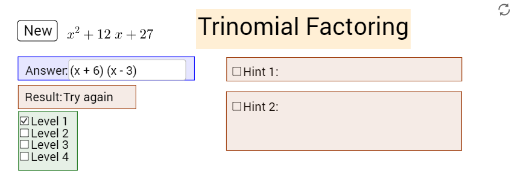
This example demonstrates the process and results of factoring trinomials. It involves core math concepts like factoring, polynomials, coefficients, and algebraic operations. GeoGebra commands/objects used in construction include Coefficients, Simplify, Textfield, If, LaTeX, Polygon, and AttachCopyToView. Suitable for middle school and above students to understand and practice factoring techniques.
GeoGebra Commands & Parameters
Coefficients(h) → list1Simplify(f) → gTextfield(h) → InputBox1Simplify(h) → iTextfield(p_a) → InputBox2Textfield(q_a) → InputBox3If(p ≟ p_a ∧ q ≟ q_a, j ≟ false ∧ e ≟ true) → kIf(p ≟ p_a ∧ q ≟ q_a, j ≟ false ∧ e ≟ true) → lLaTeX(test, true, true) → text6Polygon(A, B, C, D) → polyHint1, a_2, b_2, c_2, d_2Polygon(E, F, G, H) → polyHint2, e_2, f_2, g_2, h_2AttachCopyToView(polyHint1, 0, (-13.61033721841785, -11.743366090225695), (29.773303304999846, 11.281757544543183), (0, 449), (846, 0)) → poly1AttachCopyToView(polyHint2, 1, (-13.61033721841785, -11.743366090225699), (29.773303304999846, 11.281757544543183), (-6.999999999999998, 381), (839, -68)) → poly3AttachCopyToView(polyHint1, 1, (-13.405213622562448, -11.7433660902257), (29.97842690085525, 11.281757544543183), (-2.598594982838221, 383.0027209767809), (843.4014050171618, -65.99727902321901)) → poly4Polygon(I, J, K, L) → poly5, i_2, j_2, k_2, l_5AttachCopyToView(poly5, 1, (-11.046292270225313, -11.640804292298), (32.33734825319238, 11.384319342470883), (-535.5977186251548, 626.5040355133063), (310.40228137484496, 177.50403551330638)) → poly6Polygon(M, N, O, P) → poly2, m_2, n_2, o_2, p_2AttachCopyToView(poly2, 1, (-18.687146215839064, -16.768894188683053), (24.696494307578632, 6.256229446085831), (-22.099909519363543, 390.50578822867357), (823.9000904806364, -58.494211771326405)) → poly7Polygon(Q, R, S, T) → poly8, q_2, r_1, s_1, t_1AttachCopyToView(poly8, 1, (-17.200000145887387, -13.179231261213516), (26.183640377530313, 9.845892373555365), (-51.999999999999986, 429), (794, -19.999999999999996)) → poly9