
Powers of Complex Numbers by Juan Carlos Ponce Campuzano
Loading the math board and drawing, please wait…
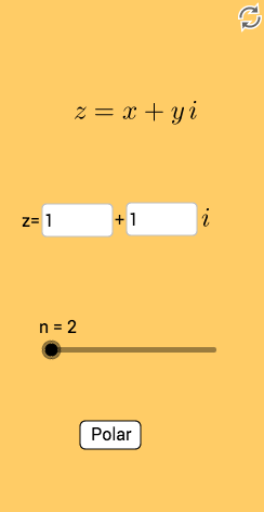
This example demonstrates the power operation of complex numbers. It shows how the power of a complex number changes on the complex plane. Key mathematical concepts include the modulus and argument of a complex number. Using GeoGebra commands such as Sequence, Circle, and CurveCartesian, the dynamic changes in complex number powers can be observed. Suitable for high school mathematics education and students learning complex number operations.
GeoGebra Commands & Parameters
Vector((0, 0), If[form ≟ true, Apolar, A]) → uAngle((10000, 0), (0, 0), Apolar) → αAngle(Apolar, (0, 0), (10000, 0)) → βTextfield(xA) → InputBox1Textfield(yA) → InputBox2Sequence(((modApolar^(i) * cos((i * thetaApolar))), (modApolar^(i) * sin((i * thetaApolar)))), i, 2, n) → list1Sequence(Angle[(1000, 0), (0, 0), Element[list1, i]], i, 1, n - 1) → list2Circle((0, 0), 1) → cSequence(Angle[Element[list1, i], (0, 0), (1000, 0)], i, 1, n - 1) → list3CurveCartesian(((a * b^(i)) * cos(i)), ((a * b^(i)) * sin(i)), i, 0, (n * thetaApolar)) → eCurveCartesian(((a * b^(i)) * cos(i)), (((-a) * b^(i)) * sin(i)), i, 0, ((-n) * thetaApolar)) → fVector((0, 0), If[form ≟ true, Z2n, Z1n]) → vTextfield(thetaApolar) → InputBox3Textfield(modApolar) → InputBox4Textfield(guessx) → InputBox5Textfield(guessy) → InputBox6