
Roots of Unity
Loading the math board and drawing, please wait…
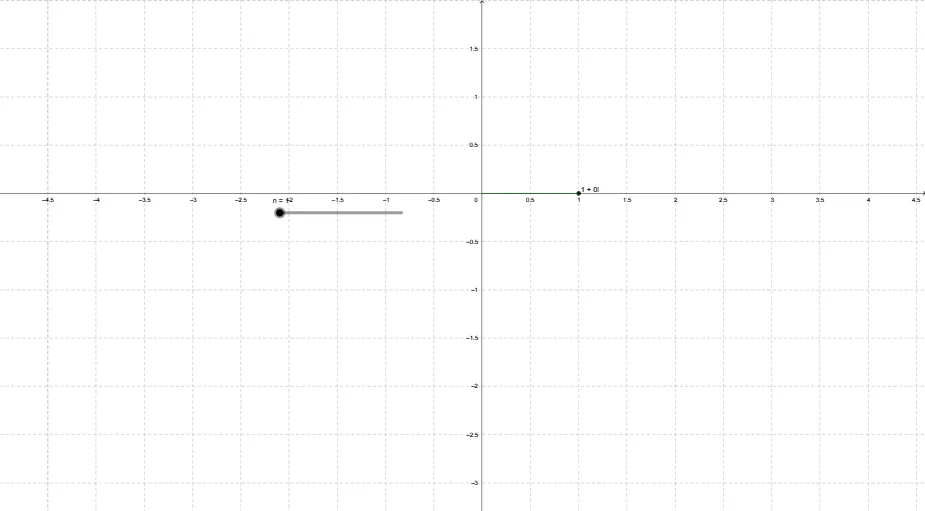
This example demonstrates the concept of roots of unity, which are complex numbers on the unit circle that satisfy z^n = 1. Using GeoGebra commands Sequence and Element, a set of roots of unity is constructed. This example involves core concepts of complex numbers and coordinate geometry, suitable for high school mathematics education.
GeoGebra Commands & Parameters
Sequence(cos(((2 * k) * π / n)) + (ί * sin(((2 * k) * π / n))), k, 0, n - 1) → list1Sequence(Segment[(0, 0), Element[list1, j]], j, 1, n) → list3Element(list1, A1) → B1Element(list1, A2) → B2Element(list1, A3) → B3Element(list1, A4) → B4Element(list1, A5) → B5Element(list1, A6) → B6Element(list1, A7) → B7Element(list1, A8) → B8Element(list1, A9) → B9Element(list1, A10) → B10Element(list1, A11) → B11Element(list1, A12) → B12Element(list1, A13) → B13Element(list1, A14) → B14Element(list1, A15) → B15Element(list1, A16) → B16Element(list1, A17) → B17Element(list1, A18) → B18Element(list1, A19) → B19Element(list1, A20) → B20
AI Drawing Prompt Reference
Draw a unit circle with n equally spaced points on its circumference, representing the n-th roots of unity. Connect each point to the center with a straight line segment, creating a radial star-like pattern. All points lie on the circle, with equal angular spacing, resulting in a symmetric and periodic figure.
The prompt above was compiled from the original drawing commands and is for reference only.