
Multiply Complex Numbers in Polar Form
Loading the math board and drawing, please wait…
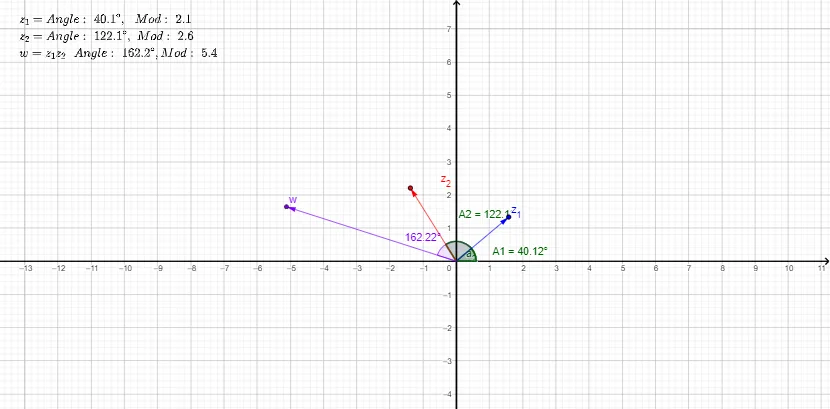
This example demonstrates the multiplication of two complex numbers in polar form, visually showing the result through vector rotation and length multiplication. It involves core concepts like polar representation of complex numbers, vector operations, angle addition, and length multiplication. GeoGebra commands used include Vector, Angle, and Length to construct complex points P_1, P_2, and the product w. Suitable for high school mathematics education to understand the geometric meaning of complex operations, and also applicable in university introductory mathematics courses.
GeoGebra Commands & Parameters
Vector(P_1) → v_1Vector(P_2) → v_2Angle(v_1) → a_1Angle(v_2) → a_2Vector(w) → v_3Length(z_1) → r_1Length(z_2) → r_2Length(w) → r_3Angle(w) → a_3Angle(P_1, z_1, P_2) → αAngle(z_1) → A1Angle(z_2) → A2
AI Drawing Prompt Reference
Draw a complex plane with two complex numbers represented as vectors from the origin. Label the length and angle of each vector relative to the positive real axis. Then draw the product vector, whose length is the product of the two lengths and whose angle is the sum of the two angles. Use dashed lines or arcs to indicate the angle addition and show the resulting length and angle values. This illustrates the geometric meaning of multiplying complex numbers in polar form.
The prompt above was compiled from the original drawing commands and is for reference only.