
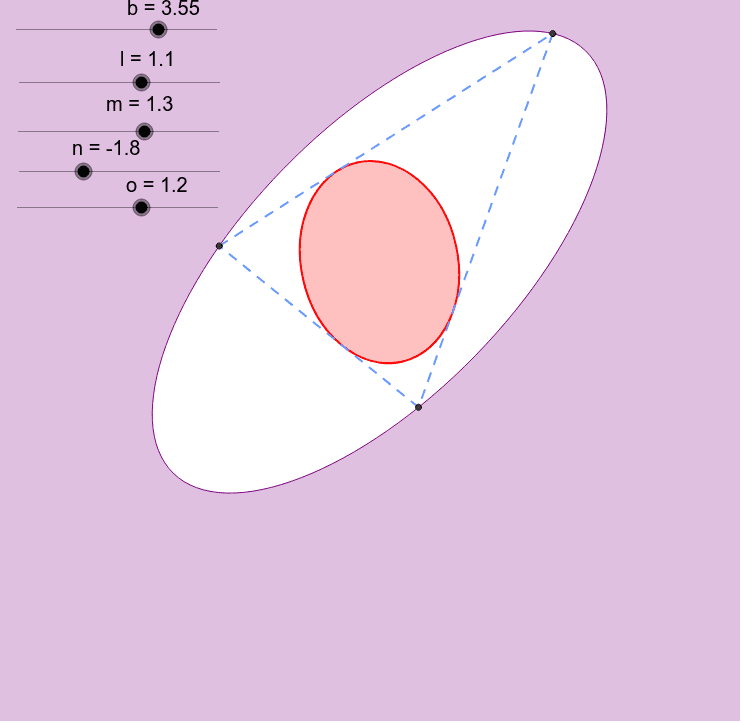
Poncelet's Porism for 2 Ellipses (order 3) by Michael Borcherds
Loading the math board and drawing, please wait…
This example illustrates Poncelet's porism for two ellipses with order 3. Key mathematical concepts include ellipses, geometric construction, and loci. Using GeoGebra commands such as Ray, Intersect, Tangent, Segment, Point, and Conic, a series of triangles with specific properties can be constructed. Suitable for high school mathematics education and research.
GeoGebra Commands & Parameters
Ray((0, 0), (sin(α), cos(α))) → kIntersect(d, k) → A,Tangent(A, c) → e, fIntersect(d, e) → B, CIntersect(d, f) → D, ESegment(C, E) → gSegment(A, C) → hSegment(C, E) → iSegment(E, A) → jPoint(c) → FPoint(c) → GPoint(c) → HPoint(c) → IPoint(c) → JPoint(d) → KPoint(d) → LConic(C', E', K', L', A') → pConic(F', G', H', I', J') → qSegment(C', A') → rSegment(A', E') → sSegment(E', C') → t
AI Drawing Prompt Reference
Draw two ellipses to illustrate Poncelet's Porism of third order. Start by drawing a ray from the origin intersecting the ellipses, then create tangent lines at the intersection points. Connect these points to form a series of triangles. Finally, link the vertices of these triangles to create a closed geometric figure, highlighting the symmetry and patterns in the construction.
The prompt above was compiled from the original drawing commands and is for reference only.