
Polynomial Roots of Unity with Complex Domain
Loading the math board and drawing, please wait…
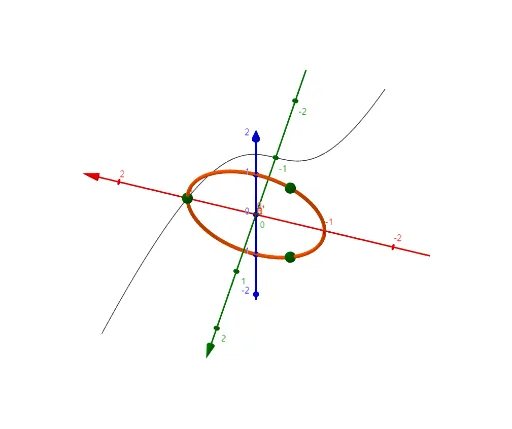
This example demonstrates graphing polynomial roots of unity within the complex domain, focusing on the real range. It involves core math concepts like complex numbers, polynomial functions, roots, and trigonometry. Construction highlights the use of GeoGebra commands/objects such as Sequence, Surface, Mirror, and CurveCartesian. Suitable for high school mathematics students and those interested in complex functions.
GeoGebra Commands & Parameters
Sequence((cos((((2 * k) * π)) / Degree), 0, sin((((2 * k) * π)) / Degree)), k, 0, Degree - 1) → l1Surface(u, ((u^(2) + v^(2))^(Degree / 2) * cos((Degree * atan(v / u)))) - 1, v, u, 0, 2, v, 0, complexreveal) → cMirror(c, z = 0) → c'CurveCartesian(u, 0, sqrt(1 - u^(2)), u, -1, 1) → aMirror(a, z = 0) → a'Surface(u, (((-1)^(If[Mod[Degree, 2] ≟ 0, 2, 1]) * (u^(2) + v^(2))^(Degree / 2)) * cos((Degree * atan(v / u)))) - 1, v, u, -2, 0, v, 0, complexreveal) → dMirror(d, z = 0) → d'
AI Drawing Prompt Reference
Draw a complex plane with unit circle roots of unity, showing symmetry. First, place points evenly on the unit circle, representing roots, with count determined by a parameter. Then, construct a 3D surface from a polynomial in the complex domain, varying with angle, and mirror it across the real plane. Next, draw the upper semicircle curve and mirror it to get the lower part. Finally, build another surface on the negative half-plane, with sign depending on parameter parity, and mirror it, forming a complete symmetric figure. The result combines unit roots with complex polynomial surfaces.
The prompt above was compiled from the original drawing commands and is for reference only.