
Complex Hyperbolic Angle and Cubic Equation Roots Visualization
Loading the math board and drawing, please wait…
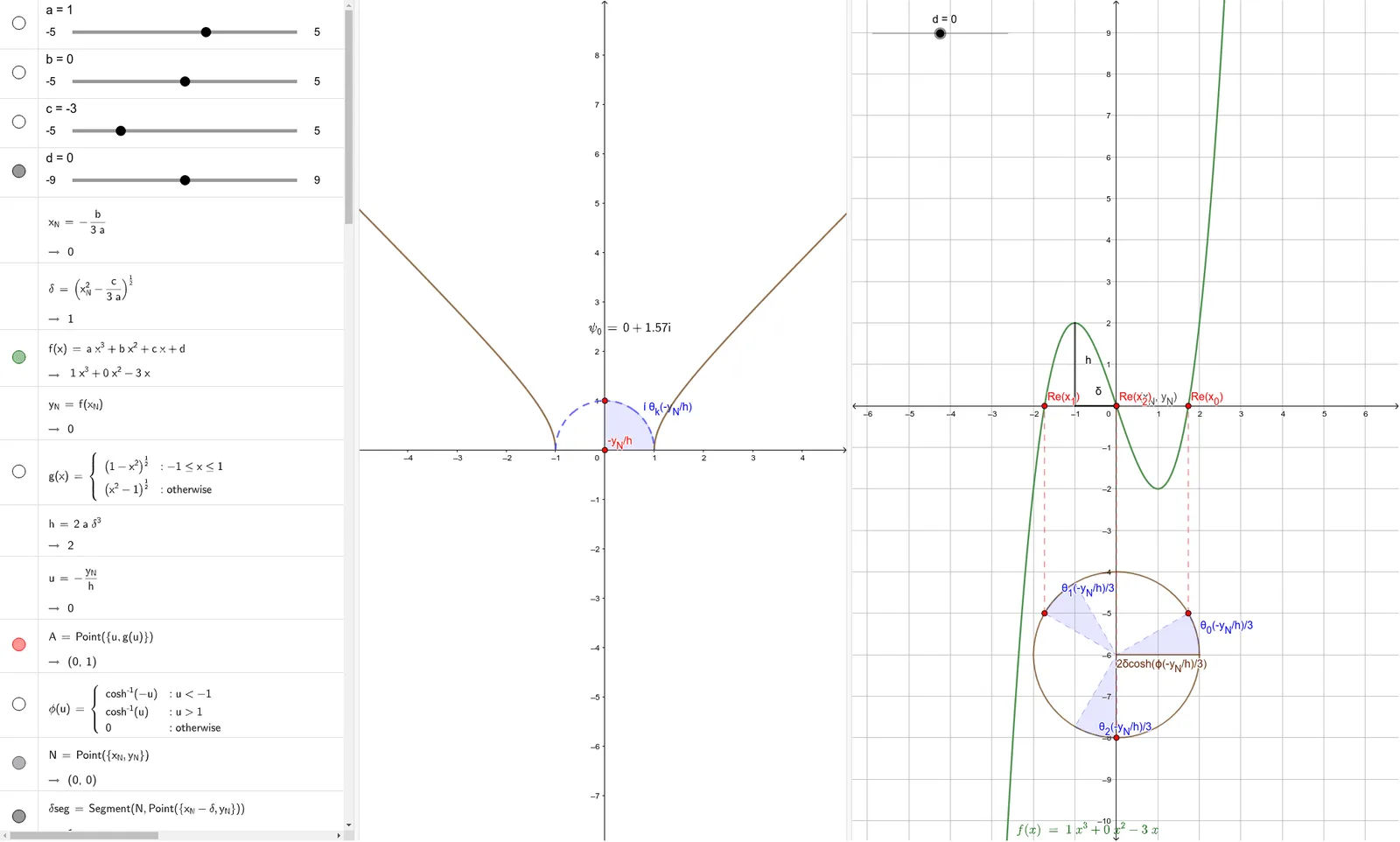
This example demonstrates the geometric relationship between the real parts of the roots of the general cubic equation ax³+bx²+cx+d=0 and complex hyperbolic angles. Through visualization on the complex plane, it shows how hyperbolic angles can help understand and locate the roots of cubic equations. Core mathematical concepts include complex number operations, cubic polynomial functions, and the geometric interpretation of hyperbolic functions. Construction highlights: Using Point commands to plot key points, Segment for line segments, CircleSector to display angle sectors, LaTeX for mathematical formulas, and IntegralBetween possibly for integral regions. Objects include polynomial coefficients a, b, c, d, root coordinates r₀, r₁, r₂, and angle parameters θ, φ, etc. Suitable for high school to university-level algebra and complex analysis courses, serving as an intuitive teaching tool for understanding the geometric meaning of complex numbers.
GeoGebra Commands & Parameters
Point({u, g(u)}) → APoint({x_{N}, y_{N}}) → NSegment(N, Point[{x_{N} - δ, y_{N}}]) → δsegSegment(Point[{x_{N} - δ, y_{N}}], Point[{x_{N} - δ, y_{N} + h}]) → hsegPoint({x_{0}(u), 0}) → r_{0}Point({x_{1}(u), 0}) → r_{1}Point({x_{2}(u), 0}) → r_{2}Point({0, 0}) → OPoint({u, sinh(ϕ(u))}) → BPoint({If[u < -1, -1, If[u > 1, 1, u]], sin(θ(0, u))}) → CPoint({1, 0}) → DSegment(O, B) → bsegCircleSector(O, D, C) → θ_{c}IntegralBetween((x^(2) - 1)^(1 / 2), bseg, u, 0) → e1LaTeX(ψ_{0}, true, true) → text1Point({u, 0}) → UPoint({x_{N}, -6}) → C_{c}Circle(C_{c}, r_{c}) → eCircleSector(C_{c}, Fref, F) → FsecCircleSector(C_{c}, Gref, G) → GsecCircleSector(C_{c}, Href, H) → HsecSegment(F, r_{0}) → FsegSegment(G, r_{1}) → GsegSegment(H, r_{2}) → HsegSegment(C_{c}, Fref) → rFseg
AI Drawing Prompt Reference
Draw a graph on the complex plane showing the relationship between the real parts of the roots of a general cubic equation and complex hyperbolic angles. Include three points on the real axis representing root coordinates, a point for hyperbolic angles, a point for angle parameters, and a sector representing the angle range. Connect these points to illustrate how hyperbolic angles help locate the roots of cubic equations.
The prompt above was compiled from the original drawing commands and is for reference only.