
Polynomial Addition Example
Loading the math board and drawing, please wait…
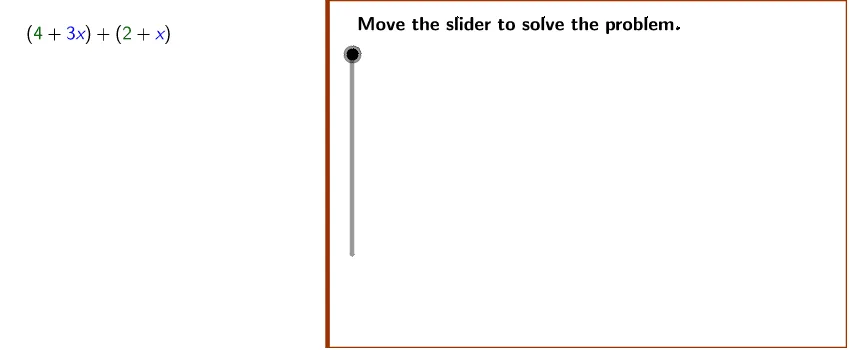
This example demonstrates how to use GeoGebra to solve the sum of polynomials [math](4 + 3x) + (2 + x)[/math]. The core math concepts involved include polynomial addition and algebraic operations. The construction utilizes commands/objects such as Polygon, If, power2, power1, linear2, linear1, constant2, constant1, Edge, Mask, a, b, c, d, steps2, AppHeader, steps, SliderDirections, Directions2, Directions1, BaseText, Directions4, finalConstant, Directions3, plus, A, linear1a, linear2a, linearFinal, linearFinala, text3, text4, Conclusion2, Conclusion3, Expression0, Expression1, Expression3, Expression2_1, Conclusion1_1, text1, text2. It is suitable for middle school students and above learning polynomial operations or as a teaching case for GeoGebra software.
GeoGebra Commands & Parameters
Polygon((Edge, y(Corner[1])), Corner[2], Corner[3], (Edge, y(Corner[4]))) → Mask, a, b, c, dIf(constant1 + constant2 ≠ 0, constant1 + constant2, "") → finalConstantIf(abs(linear1) ≟ 1, If[linear1 ≟ 1, "", "-"], LaTeX[linear1]) → linear1aIf(abs(linear2) ≟ 1, If[linear2 ≟ 1, "", "-"], LaTeX[linear2]) → linear2aIf(abs(linearFinal) ≟ 1, If[linearFinal ≟ 1, "", "-"], LaTeX[linearFinal]) → linearFinala
AI Drawing Prompt Reference
Create a geometric illustration showing the addition of polynomials (4+3x) and (2+x), using coordinate geometry with sliders to control coefficients, and display the calculation process and algebraic steps, suitable for middle school students learning polynomial operations.
The prompt above was compiled from the original drawing commands and is for reference only.