
Polygons 6: Geometric Mean, Functions, and Conditional Probability Exploration
Loading the math board and drawing, please wait…
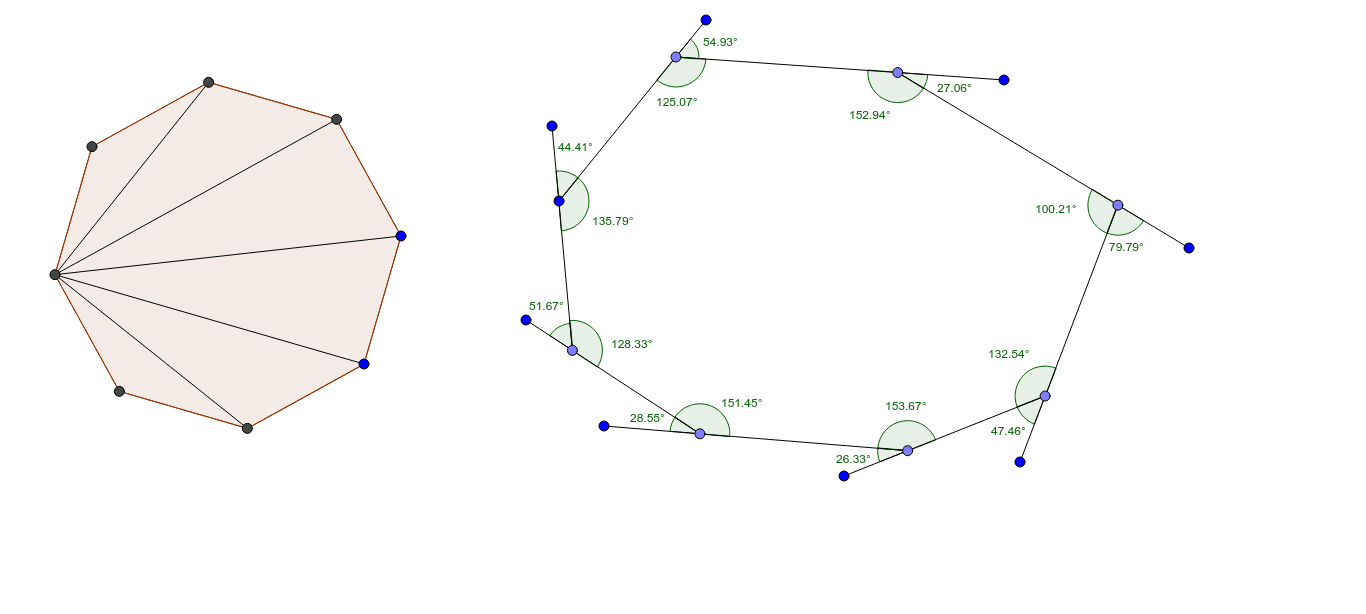
①This GeoGebra example presents a comprehensive mathematical scene combining polygons, a parabola, random experiments, and conditional probability, demonstrating interactions among multiple geometric and probabilistic objects. ②Core concepts include polygon properties, geometric mean, function graphs (especially parabolas), random experiments, and conditional probability, integrating algebra, geometry, and statistics. ③Construction highlights: using Polygon command to create poly1, along with Segment, Point, Intersect, and Angle commands to define points A, B, C, D, etc., and segments f through e, plus function objects and random experiment elements, forming an interactive environment. ④Suitable for high school and above, ideal for integrated math lessons, cross-disciplinary projects, or teacher demonstrations to help students grasp connections between geometry and probability and enhance dynamic modeling skills.
GeoGebra Commands & Parameters
Polygon(A, B, 8) → poly1, f, D, E, F, G, H, g, h, i, j, k, l, m, CSegment(F, H) → nSegment(F, A) → pSegment(F, B) → qSegment(F, C) → rSegment(F, D) → sSegment(I, J) → tPoint(t) → KSegment(K, L) → aPoint(a) → MSegment(M, N) → bPoint(b) → OSegment(O, P) → cPoint(c) → QSegment(Q, R) → dPoint(d) → SSegment(S, T) → ePoint(e) → USegment(U, V) → f_1Point(f_1) → WSegment(W, Z) → g_1Intersect(g_1, t) → A_1Intersect(g_1, t) → B_1Intersect(g_1, t) → C_1Angle(I, K, M) → αAngle(K, M, O) → βAngle(M, O, Q) → γAngle(O, Q, S) → δAngle(Q, S, U) → εAngle(S, U, W) → ζAngle(U, W, I) → ηAngle(W, I, K) → θAngle(K, I, Z) → ιAngle(I, W, V) → κAngle(W, U, T) → λAngle(U, S, R) → μAngle(S, Q, P) → νAngle(Q, O, N) → ξAngle(O, M, L) → οAngle(M, K, J) → ρ