
Polar Representation of Vectors
Loading the math board and drawing, please wait…
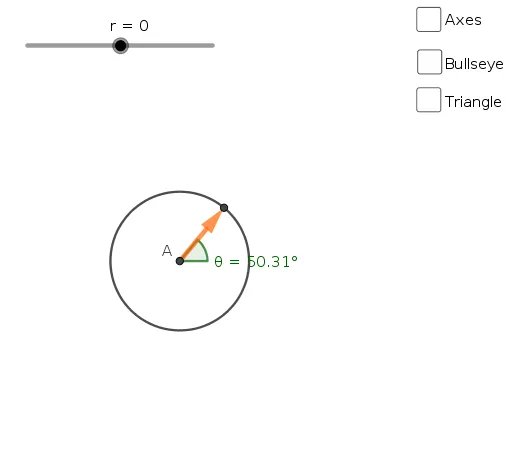
This example demonstrates the polar representation of vectors. Key mathematical concepts include vectors and trigonometry. Using GeoGebra commands such as Intersect, Circle, Point, and Vector, the polar representation of vectors is constructed. Suitable for high school mathematics education and learning.
GeoGebra Commands & Parameters
Intersect(xAxis, yAxis) → ACircle(A, 1) → cPoint(c) → EVector(A, E) → uVector(A, B) → vOrthogonalLine(B, xAxis) → fIntersect(f, xAxis) → CSegment(A, C) → v_1Segment(C, B) → v_2Sequence(Circle[A, i], i, 1, n) → L_1Sequence(Circle[A, i + 0.5], i, 0, n - 1) → L_2Sequence(Circle[A, i + 0.75], i, 0, n - 1) → L_3Sequence(Circle[A, i + 0.25], i, 0, n - 1) → L_4Midpoint(A, B) → DRay(A, B) → gAngle(u) → θ
AI Drawing Prompt Reference
Draw a Cartesian coordinate system with the origin O, where the x-axis is horizontal and the y-axis is vertical. Draw a unit circle centered at O. Choose a point E on the circle and draw vector u from O to E. Draw vector v from O to B, which is perpendicular to the x-axis. Connect OC and draw line segments v_1 from C to B and v_2 from C to O. Draw four concentric circles around O with radii 1, 1.5, 1.75, and 2.25. Connect OB and draw a ray g from O to B. Calculate the polar angle θ of vector u.
The prompt above was compiled from the original drawing commands and is for reference only.