
Polar Conics Eccentricity & Directrix
Loading the math board and drawing, please wait…
In collections
Conics Doug Kuhlmann
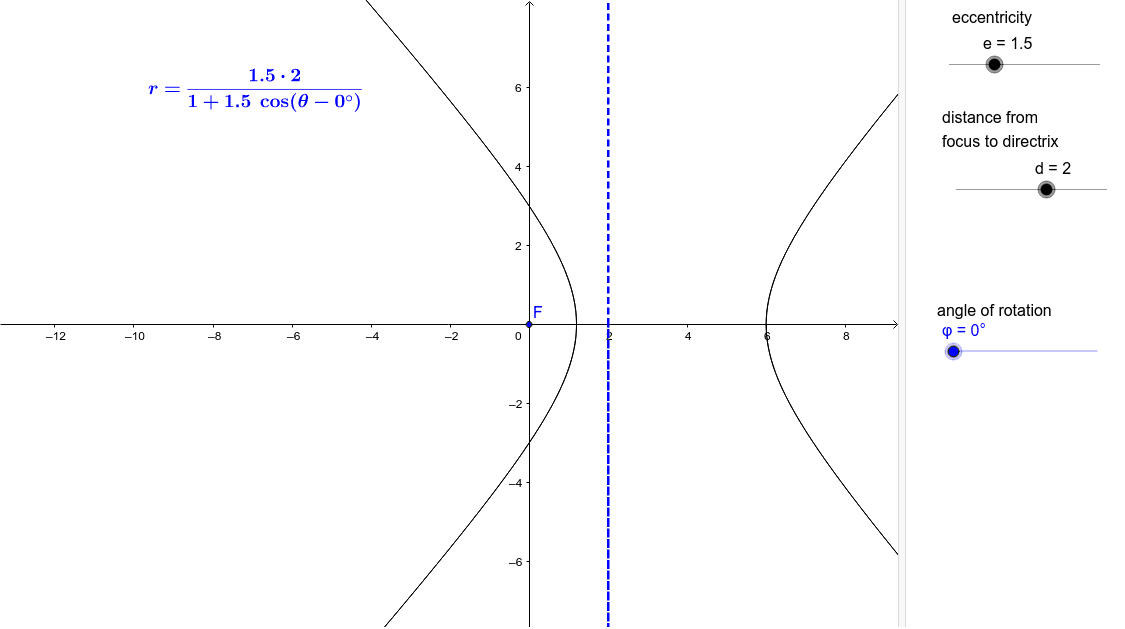
This example demonstrates the geometric relationship between eccentricity and directrix of conic sections (ellipse, hyperbola, parabola) in polar coordinates. Key concepts include polar coordinate equations, eccentricity, directrix, and classification of conic sections. Construction highlights involve using GeoGebra commands like CurveCartesian with parameters φ (polar angle), e (eccentricity), d (directrix distance), r (polar radius), b (parameter), F (focus), a (semi-major axis), rd (related distance), rDefn (polar radius definition), d_1 (directrix), Eccentricity (displaying eccentricity), dDefn (directrix definition), and RotAngle (rotation angle). Suitable for high school students and math enthusiasts studying properties of conic sections and polar coordinates applications.
GeoGebra Commands & Parameters
CurveCartesian((r(θ) * cos(θ)), (r(θ) * sin(θ)), θ, -6.28319, 6.28319) → aCurveCartesian((rd(θ) * cos(θ)), (rd(θ) * sin(θ)), θ, 0, 6.2831) → d_1
AI Drawing Prompt Reference
Draw conic sections in polar coordinates to demonstrate the geometric relationship between eccentricity and directrix, including ellipse, hyperbola, and parabola. Define the curves using polar coordinate equations and label eccentricity, directrix distance, and focus. First draw the polar radius from the focus to the curve, then the directrix, and finally show the numerical relationship between eccentricity and directrix.
The prompt above was compiled from the original drawing commands and is for reference only.