
Polar Area Calculation
Loading the math board and drawing, please wait…
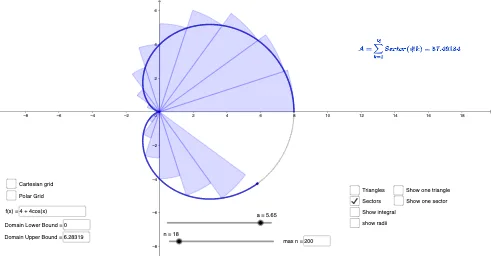
This example demonstrates how to calculate area using polar coordinates. It involves core mathematical concepts such as integration and limits. Using GeoGebra commands like CurveCartesian and Integral, a polar area calculation model can be constructed. Suitable for high school and above students to learn methods of area calculation in calculus.
GeoGebra Commands & Parameters
CurveCartesian(((g(t) * cos(t)), (g(t) * sin(t))), t, a_s, a) → bSequence(a_s + (d / n * i), i, 0, n) → L_1Sequence(((1 - e) * Element[L_1, i]) + (e * Element[L_1, i + 1]), i, 1, n) → l3Textfield(f) → InputBox1Sequence(x = i, i, -30, 30) → l9Sequence(y = i, i, -30, 30) → l10Sequence(x^(2) + y^(2) = i^(2), i, 1, 20) → l11Textfield(a_s) → InputBox4Textfield(a_f) → InputBox5Integral((1 / 2 * (f(x))^(2)), a_s, a) → iTextfield(m) → InputBox6Textfield(a_s) → InputBox2_1Textfield(a_s) → InputBox4_1Textfield(a_s) → InputBox2_2Textfield(a_s) → InputBox4_2Textfield(a_s) → InputBox2_3Textfield(a_s) → InputBox4_3CurveCartesian(((f(t) * cos(t)), (f(t) * sin(t))), t, a_s, a_f) → cSequence(b(Element[l3, i]), i, 1, n) → l1Sequence(b(Element[L_1, i]), i, 1, n + 1) → l2Sequence(Segment[A, Element[l1, i]], i, 1, n) → l4Sequence(If[Length[Element[l4, i]] > 0.0001, Length[Element[l4, i]], 0.0001], i, 1, n) → l5Sequence(Circle[A, Element[l5, i]], i, 1, n) → l6Sequence(Ray[A, Element[l2, i]], i, 1, n + 1) → l7Sequence(Intersect[Element[l6, i], Element[l7, i]], i, 1, n) → l8Sequence(Intersect[Element[l6, i], Element[l7, i + 1]], i, 1, n) → l12Sequence(CircleSector[A, Element[l8, i], Element[l12, i]], i, 1, n) → l13Sequence(Polygon[A, Element[l8, i], Element[l12, i]], i, 1, n) → l14Element(l14, 2) → t1Angle(Element[l8, 2], A, Element[l8, 3]) → αSegment(A, Element[l8, 3]) → hElement(l13, 2) → c_1Sequence(Area[Element[l13, i]], i, 1, n) → l15Sum(l15) → s_sSequence(Area[Element[l14, i]], i, 1, n) → l16Sum(l16) → s_t
AI Drawing Prompt Reference
Draw a polar coordinate graph using the function f(t) = t^2. Calculate the area under this function in the interval [a_s, a_f] using integration. Draw a series of concentric circles and rays, calculate the area of each sector, and sum them up to get the total area.
The prompt above was compiled from the original drawing commands and is for reference only.