
Polar and Rectangular Coordinates by Jamie Hansen
Loading the math board and drawing, please wait…
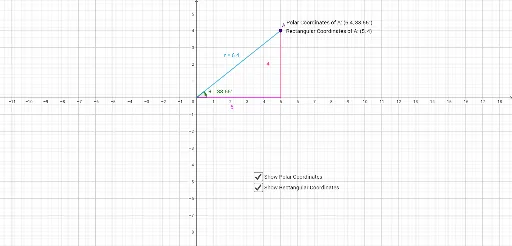
This example demonstrates the conversion between polar and rectangular coordinates. Key mathematical concepts include coordinate system conversion and the relationship between angles and distances. Using GeoGebra commands such as OrthogonalLine, Intersect, and Segment, the process of coordinate conversion can be visually understood. Suitable for high school mathematics education and learning.
GeoGebra Commands & Parameters
OrthogonalLine(A, xAxis) → fIntersect(f, xAxis) → BSegment(A, B) → bIntersect(xAxis, yAxis) → CSegment(C, B) → cPoint(xAxis) → DAngle(D, C, A) → θSegment(C, A) → rMidpoint(c) → EMidpoint(c) → FMidpoint(b) → G
AI Drawing Prompt Reference
Draw a Cartesian coordinate system with x and y axes. From the origin, draw a perpendicular line to the x-axis and mark a point on it. Connect the origin to this point. Then, draw a perpendicular line from this point to the x-axis and mark the intersection point. Connect these two points. Label the lengths of the segments and the angle between them, and mark the midpoints of both segments to illustrate the conversion between polar and rectangular coordinates.
The prompt above was compiled from the original drawing commands and is for reference only.