
Points of Intersection 28
Loading the math board and drawing, please wait…
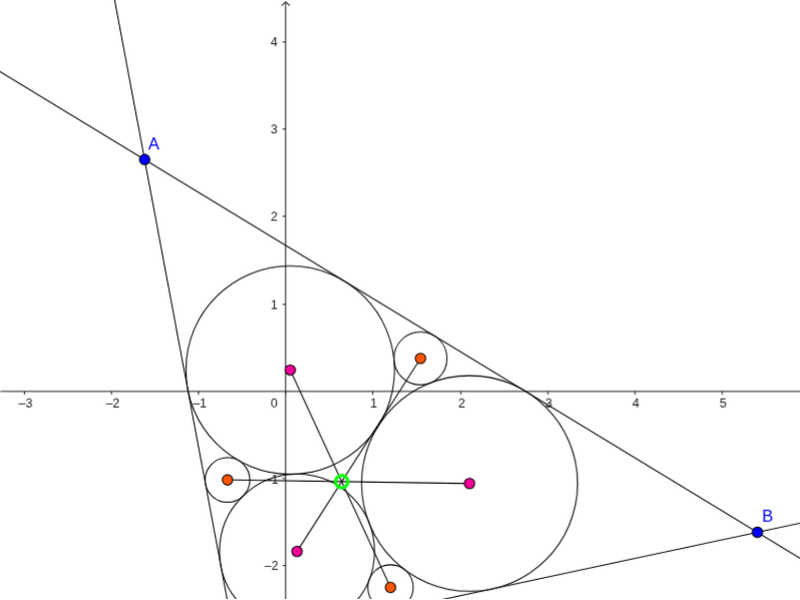
This example demonstrates the intersection of points, involving concepts such as angle bisectors, perpendicular lines, circles, segments, mirroring, and similarity transformations. Using GeoGebra commands like Line, AngularBisector, Intersect, and OrthogonalLine, complex geometric figures can be constructed. Suitable for high school mathematics education and learning.
GeoGebra Commands & Parameters
Line(A, B) → aLine(B, C) → bLine(C, A) → cAngularBisector(C, A, B) → dAngularBisector(A, B, C) → eAngularBisector(B, C, A) → fIntersect(d, e) → DAngularBisector(C, A, D) → gAngularBisector(D, C, A) → hIntersect(g, h) → EOrthogonalLine(E, c) → iIntersect(c, i) → FCircle(E, F) → kAngularBisector(D, A, B) → jAngularBisector(D, B, A) → lIntersect(j, l) → GOrthogonalLine(G, a) → mIntersect(a, m) → HCircle(G, H) → pAngularBisector(B, C, D) → nAngularBisector(D, B, C) → qIntersect(n, q) → IOrthogonalLine(I, b) → rIntersect(b, r) → JCircle(I, J) → sIntersect(k, d) → K, NIntersect(p, d) → L, MSegment(E, G) → tMirror(d, t) → d'Segment(E, I) → a_1Segment(I, G) → b_1Mirror(e, b_1) → e'Mirror(f, a_1) → f'Intersect(d', e') → OAngularBisector(O, F, A) → c_1AngularBisector(A, H, O) → d_1Intersect(d, c_1) → POrthogonalLine(P, a) → e_1Intersect(a, e_1) → QCircle(P, Q) → f_1AngularBisector(O, J, B) → g_1Intersect(e, g_1) → ROrthogonalLine(R, a) → h_1Intersect(a, h_1) → SCircle(R, S) → k_1AngularBisector(O, J, C) → i_1Intersect(i_1, f) → TOrthogonalLine(T, b) → j_1Intersect(b, j_1) → UCircle(T, U) → p_1Intersect(p_1, k_1) → V, , ,OrthogonalLine(V, b) → l_1Intersect(b, l_1) → WCircle(V, W) → q_1Dilate(q_1, 0.5, W) → r_1Intersect(k_1, q_1) → Z, A_1, ,Line(A_1, Z) → m_1Midpoint(V, W) → B_1Line(B_1, m_1) → n_1Intersect(r_1, n_1) → C_1, D_1Mirror(r_1, D_1) → s_1Mirror(s_1, q_1) → t_1Intersect(f_1, p_1, 1) → E_1OrthogonalLine(E_1, c) → a_2Intersect(c, a_2) → F_1Midpoint(F_1, E_1) → G_1Circle(G_1, F_1) → c_2Circle(E_1, F_1) → d_2Intersect(f_1, d_2) → H_1, I_1, ,Line(I_1, H_1) → b_2Line(G_1, b_2) → e_2Intersect(c_2, e_2) → J_1, K_1Mirror(c_2, J_1) → f_2Mirror(f_2, d_2) → g_2Intersect(f_1, k_1, 1) → L_1OrthogonalLine(L_1, a) → h_2Intersect(a, h_2) → M_1Midpoint(M_1, L_1) → N_1Circle(L_1, M_1) → k_2Circle(N_1, M_1) → p_2Intersect(k_2, f_1) → O_1, P_1, ,Line(P_1, O_1) → i_2Line(N_1, i_2) → j_2Intersect(p_2, j_2) → Q_1, R_1Mirror(p_2, Q_1) → q_2Mirror(q_2, k_2) → r_2Center(f_1) → S_1Center(p_1) → T_1Center(k_1) → U_1Center(r_2) → V_1Center(g_2) → W_1Center(t_1) → Z_1Segment(S_1, Z_1) → l_2Segment(T_1, V_1) → m_2Segment(W_1, U_1) → n_2Intersect(l_2, m_2) → A_2