
Pick's Theorem
Loading the math board and drawing, please wait…
In collections
Coordinate Geometry
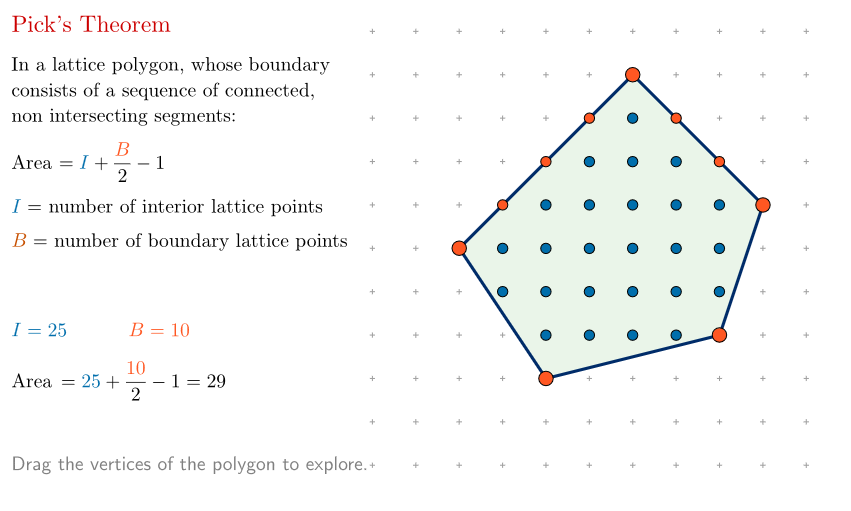
This example demonstrates how to quickly calculate the area of a polygon with integer coordinates using Pick's Theorem. Key mathematical concepts include coordinate geometry and integer coordinates. Using GeoGebra commands such as Join, Point, and Polygon, the theorem's application is visually demonstrated. Suitable for middle school and above students to learn polygon area calculation.
GeoGebra Commands & Parameters
Join(Sequence[Sequence[(j, k), j, 0, 10], k, 0, 10]) → LatticePoint(Lattice) → EPoint(Lattice) → DPoint(Lattice) → CPoint(Lattice) → BPoint(Lattice) → APolygon(A, B, C, D, E) → poli1, a, b, c, d, ePolyLine(A, B, C, D, E, A) → bordoKeepIf(P ∈ bordo, P, Lattice) → soloBordoLength(soloBordo) → countBordoKeepIf(IsInRegion[P, poli1], P, Lattice) → nelPoliLength(soloInt) → countSoloIntLength(nelPoli) → countPoligono
AI Drawing Prompt Reference
Draw a polygon with integer coordinates, connect these points to form a closed shape. Then mark these integer coordinate points, count the number of integer points inside and on the boundary of the polygon, and use Pick's Theorem to calculate the area of the polygon.
The prompt above was compiled from the original drawing commands and is for reference only.