
Phone Friendly: Pythagoras's Theorem
Loading the math board and drawing, please wait…
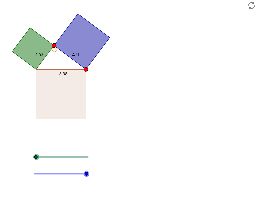
This example demonstrates the proof of Pythagoras's Theorem through shearing. It involves core mathematical concepts like Pythagorean Theorem, transformation, and vectors. The construction utilizes GeoGebra commands and objects such as Intersect, Point, Semicircle, Midpoint, Circle, Rotate, Line, Vector, Length, If, Polygon, and Angle. Suitable for high school mathematics teaching or self-study to understand the geometric proof of the theorem.
GeoGebra Commands & Parameters
Intersect(xAxis, yAxis) → APoint(xAxis) → BSemicircle(A, B) → hMidpoint(A, B) → OCircle(O, B) → oPoint(h) → CRotate(C, 90°, A) → DRotate(A, 270°, C) → ELine(D, E) → mVector(D, E) → v_bLength(v_b) → k_bRotate(C, 270°, B) → FRotate(B, 90°, C) → GLine(F, G) → nIntersect(m, n) → HLine(H, yAxis) → hcVector(E, H) → u_aLength(u_a) → ku_bVector(G, H) → u_bLength(u_b) → ku_aVector(F, G) → v_aLength(v_a) → k_aRotate(B, 270°, A) → IVector(A, I) → v_cLength(v_c) → k_cCircle(H, (ku_a * ku_b / k_c)) → dIntersect(d, hc) → K, LVector(H, L) → v_hRotate(A, 90°, B) → JIf(a < ka_1, Point[F, Vector[(a / ka_1 * u_b)]], If[a < ka_2, Point[F, u_b], Point[F, Vector[u_b + ((a - ka_2) / (1 - ka_2) * v_c)]]]) → F'Polygon(B, C, G, F) → P, b_1, c, g, fIf(a < ka_1, Point[G, Vector[(a / ka_1 * u_b)]], If[a < ka_2, Point[H, Vector[((a - ka_1) / (ka_2 - ka_1) * v_h)]], Point[L, Vector[((a - ka_2) / (1 - ka_2) * v_c)]]]) → G'If(a < ka_1, C, If[a < ka_2, Point[C, Vector[((a - ka_1) / (ka_2 - ka_1) * v_h)]], Point[C, Vector[v_h + ((a - ka_2) / (1 - ka_2) * v_c)]]]) → Ca'Vector(G', Ca') → uIf(a < ka_1, B, If[a < ka_2, B, Point[B, Vector[((a - ka_2) / (1 - ka_2) * v_c)]]]) → B'Vector(F', B') → vPolygon(B', Ca', G', F') → Q, b', c', g', f'If(b < kb_1, Point[E, Vector[(b / kb_1 * u_a)]], If[b < kb_2, Point[H, Vector[((b - kb_1) / (kb_2 - kb_1) * v_h)]], Point[L, Vector[((b - kb_2) / (1 - kb_2) * v_c)]]]) → E'If(b < kb_1, Point[D, Vector[(b / kb_1 * u_a)]], If[b < kb_2, Point[D, u_a], Point[D, Vector[u_a + ((b - kb_2) / (1 - kb_2) * v_c)]]]) → D'If(b < kb_1, C, If[b < kb_2, Point[C, Vector[((b - kb_1) / (kb_2 - kb_1) * v_h)]], Point[C, Vector[v_h + ((b - kb_2) / (1 - kb_2) * v_c)]]]) → Cb'If(b < kb_1, A, If[b < kb_2, A, Point[A, Vector[((b - kb_2) / (1 - kb_2) * v_c)]]]) → A'Polygon(A, C, E, D) → R, a_1, c_1, e, d_1Polygon(A', Cb', E', D') → S, a', cb', e', d'Polygon(A, B, J, I) → T, a_2, b_2, j, iAngle(A, C, B) → αMidpoint(C, B) → MMidpoint(A, C) → NMidpoint(a_2) → U
AI Drawing Prompt Reference
Draw a right triangle to demonstrate the Pythagorean theorem. Show the proof by shearing the triangle into three congruent smaller triangles. Label the lengths of each side and draw auxiliary lines, circles, and vectors. Include geometric elements like a semicircle, rotations, and vector length calculations to prove the relationship between the sides, clearly illustrating the theorem's geometric meaning.
The prompt above was compiled from the original drawing commands and is for reference only.