
Phasor Subtraction: Tip-to-Tail Method
Loading the math board and drawing, please wait…
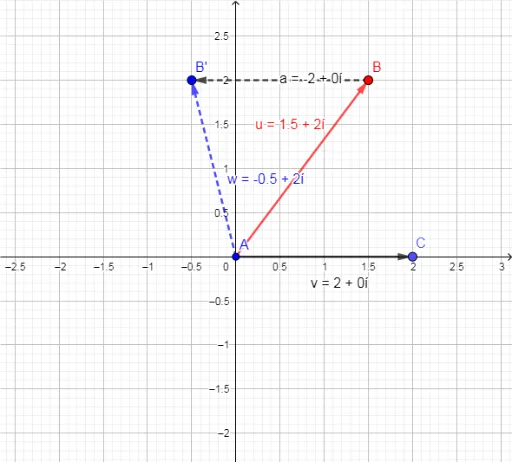
①This GeoGebra example dynamically demonstrates the subtraction of two phasors (vectors) using the tip-to-tail geometric construction, visually showing the resultant vector of the subtraction. ②The core mathematical concept is two-dimensional vector subtraction, where subtracting vector b from vector a is equivalent to adding the opposite of b to a; the tip-to-tail method clarifies the direction and magnitude of the difference vector. ③Construction details: the example uses GeoGebra commands such as Intersect to find intersection points, Vector to create vectors u and v, and Translate to shift vectors for the tip-to-tail arrangement; objects include points A, B, C, vectors u, v, w, translated point B', and vector a, forming a complete subtraction diagram. ④This is suitable for high school or early college students learning vector operations, analytic geometry, or phasor analysis in physics, and also serves as a classroom demonstration tool for teachers to connect geometric intuition with algebraic computation.
GeoGebra Commands & Parameters
Intersect(xAxis, yAxis) → AVector(A, B) → uVector(A, C) → vTranslate(B, (-v)) → B'Vector(B, B') → aVector(u - v) → w
AI Drawing Prompt Reference
Draw a 2D coordinate plane with two vectors originating from the origin, one pointing to the upper right and the other to the upper left. Translate the second vector in the opposite direction so that its tail coincides with the tip of the first vector, creating a tip-to-tail arrangement. Then draw a new vector from the origin to the tip of the translated vector, representing the difference of the two original vectors. Use dashed lines or distinct colors for the translated vector, and keep the original vectors visible to illustrate the geometric subtraction.
The prompt above was compiled from the original drawing commands and is for reference only.