
Phantom Graphs Newton's Diverging Parabolas
Loading the math board and drawing, please wait…
In collections
Phantom Graphs
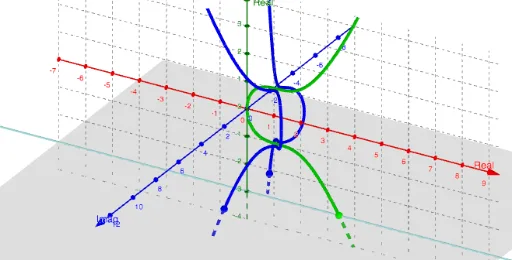
This example demonstrates the complex plane visualization of Newton's Diverging Parabolas, showcasing dynamic behavior and fractal characteristics. Key mathematical concepts include complex numbers, quadratic equations, statistical properties, fractal geometry, and surface analysis. The construction utilizes GeoGebra commands like Plane, ComplexRoot, and CurveCartesian, along with objects such as curves, points, and sliders. It is suitable for high school and advanced learners exploring complex function graphs and fractal geometry applications.
GeoGebra Commands & Parameters
Plane((0, c, 0), (1, c, 0), (0, c, 1)) → pComplexRoot((A * c^(2)) - (x * (x^(2) - ((2 * B) * x) + C))) → z_1, z_2, z_3CurveCartesian(t, sqrt((((16 * B) * t^(2)) - ((8 * B^(2)) * t) - (8 * t^(3)) + ((2 * B) * C) - ((2 * C) * t)) / A), sqrt((3 * t^(2)) - ((4 * B) * t) + C), t, -25, 25) → dCurveCartesian(t, (-sqrt((((16 * B) * t^(2)) - ((8 * B^(2)) * t) - (8 * t^(3)) + ((2 * B) * C) - ((2 * C) * t)) / A)), sqrt((3 * t^(2)) - ((4 * B) * t) + C), t, -25, 25) → eCurveCartesian(t, sqrt((((16 * B) * t^(2)) - ((8 * B^(2)) * t) - (8 * t^(3)) + ((2 * B) * C) - ((2 * C) * t)) / A), (-sqrt((3 * t^(2)) - ((4 * B) * t) + C)), t, -25, 25) → fCurveCartesian(t, (-sqrt((((16 * B) * t^(2)) - ((8 * B^(2)) * t) - (8 * t^(3)) + ((2 * B) * C) - ((2 * C) * t)) / A)), (-sqrt((3 * t^(2)) - ((4 * B) * t) + C)), t, -25, 25) → h