
Percentages(I): Profit and Loss
Loading the math board and drawing, please wait…
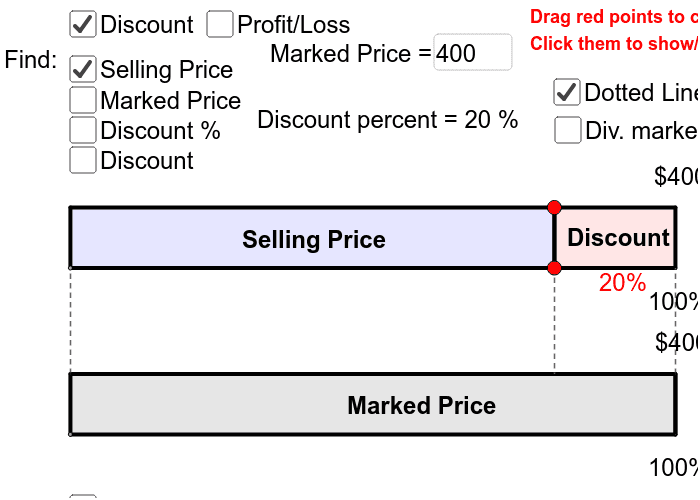
This example demonstrates how to visualize profit and loss calculations through geometric representations. Key math concepts include percentage calculations, geometric operations, and data analysis. GeoGebra commands and objects like Point, Polygon, Intersect, Sequence, Textfield, Midpoint, If, Segment are used to construct shapes, calculate lengths, widths, and percentage changes. Suitable for middle school and above students learning percentage applications, geometric computations, and data analysis.
GeoGebra Commands & Parameters
Point(yAxis) → APoint(yAxis) → BPoint(Segment[A, A + (length * maxchange, 0)]) → PPoint(Segment[A + (0, width), A + (length * maxchange, width)]) → QPolygon(A, P, P + (0, width), A + (0, width)) → poly1, poly1a, poly1d, poly1b, poly1cPolygon(B, B + (length, 0), B + (length, width), B + (0, width)) → poly2, poly2b, poly2a, poly2c, poly2dIntersect(Ray[P, P + (1, 0)], x = length) → A1Intersect(Ray[Q, Q + (1, 0)], x = length) → A2Intersect(Ray[B1, B1 + (1, 0)], x = x(P)) → P'Intersect(Ray[B2, B2 + (1, 0)], x = x(P)) → Q'Polygon(P, Q, A2, A1) → poly3, poly3b, poly3b_1, poly3d, poly3cPolygon(B1, B2, Q', P') → poly4, poly4c, poly4d, poly4b, poly4aSequence(Segment[B + (i * length / 10, 0), B + (i * length / 10, width)], i, 1, 9) → list1Sequence(Sequence[Segment[B + (j * length / 100 + i * length / 10, 0), B + (j * length / 100 + i * length / 10, width)], j, 1, 9], i, 0, 9) → list2Sequence(Segment[A + (i * length / 10, 0), A + (i * length / 10, width)], i, 1, 9) → list3Sequence(Sequence[Segment[A + (j * length / 100 + i * length / 10, 0), A + (j * length / 100 + i * length / 10, width)], j, 1, 9], i, 0, 9) → list4Textfield(cost) → inputBox1Textfield(cost) → inputBox2Midpoint(B, B2) → CMidpoint(A, Q) → DMidpoint(P, A2) → EMidpoint(B1, Q') → FMidpoint(B1, Q') → GTextfield(price) → inputBox3Midpoint(P, A1) → HMidpoint(poly4a) → IMidpoint(poly3b_1) → JMidpoint(poly4d) → KIf(o_2, "$ y", "$" + cost) → text9If(o_2, "$ y", "$" + cost) → text4If(o_3, "y %", abs(change_%) * "%") → text11If(o_1, "$ y", "$" + price) → text13If(change_% < 0, "-", "+") → text24If(o_3, "y %", abs(change_%) * "%") → text17If(o_3, "1 " * text24 * " y %", "1 " + (text24 * " " * abs(change_%) * "%")) → text34If(o_3, "1 " * text24 * " y %", "1 " + (text24 * " " * abs(change_%) * "%")) → text14If(o_1 ∨ o_4, If[o_1, "$ y", cost * " " * text24 * " $ y"], "$" + price) → text12If(o_4, cost * " " * text24 * " $ y", "$" + price) → text15Textfield(price) → inputBox4Segment(B + (0, width), A) → gSegment(B2, A + (length, 0)) → iSegment(P, If[x(P) < length, Intersect[poly2c, x = x(P)], Intersect[poly4d, x = x(P)]]) → hSequence(Segment[A + (i * length / 10, 0), A + (i * length / 10, width)], i, 1, floor(x(P) / length * 10)) → list3_1Sequence(Sequence[Segment[A + (j * length / 100 + i * length / 10, 0), A + (j * length / 100 + i * length / 10, width)], j, 1, 9], i, 0, floor(x(P) / length * 10) - 1) → list4_1Sequence(Segment[B + (i * length / 10, 0), B + (i * length / 10, width)], i, 1, floor(x(P) / length * 10)) → list5Sequence(Sequence[Segment[B + (j * length / 100 + i * length / 10, 0), B + (j * length / 100 + i * length / 10, width)], j, 1, 9], i, 0, floor(x(P) / length * 10) - 1) → list6_1Sequence(Segment[A + (j * length / 100 + floor(x(P) / length * 10) * length / 10, 0), A + (j * length / 100 + floor(x(P) / length * 10) * length / 10, width)], j, 1, floor((x(P) - floor(x(P) / length * 10) * length / 10) / length * 100)) → list4_2Sequence(Segment[B + (j * length / 100 + floor(x(P) / length * 10) * length / 10, 0), B + (j * length / 100 + floor(x(P) / length * 10) * length / 10, width)], j, 1, floor((x(P) - floor(x(P) / length * 10) * length / 10) / length * 100)) → list6_2If(b ∧ (change_% < 0), "Loss", "Discount") → text8If(b, "Cost", "Marked Price") → text6