
Pentagon Angle Theorems via Transformational Geometry by Mrs. Cole
Loading the math board and drawing, please wait…
In collections
Interior and Exterior Angles of Polygons
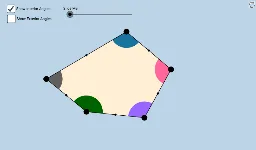
This GeoGebra applet uses transformational geometry tools to help students discover the sum of interior and exterior angles of a pentagon. It demonstrates that the sum of interior angles is (n-2)×180° = 540° for a pentagon, and the sum of exterior angles is always 360°. The construction employs commands such as Segment, Midpoint, Ray, Circle, Intersect, CircleSector, Vector, Translate, Mirror, Dilate, Rotate, Line, If, Point, Polygon, and CircleArc. By translating, rotating, or reflecting angles, the applet visually collects all interior or exterior angles at a common vertex or along a line, making the angle-sum relationships evident. This is ideal for middle school or high school geometry classes, supporting inquiry-based learning and reinforcing concepts of angle sums, transformations, and geometric proof.
GeoGebra Commands & Parameters
Segment(D, E) → i_3Midpoint(i_3) → M_3Ray(A, B) → aRay(B, C) → bRay(C, D) → cRay(D, E) → dRay(E, A) → eCircle(A, 1.5) → fCircle(B, 1.5) → gCircle(C, 1.5) → hCircle(D, 1.5) → kCircle(E, 1.5) → pSegment(C, A) → iSegment(C, E) → jIntersect(f, a, 1) → FIntersect(f, i, 1) → GIntersect(f, e, 1) → HIntersect(f, e, 2) → IIntersect(p, e) → J,Intersect(p, j) → K,Intersect(p, d, 1) → LIntersect(p, d, 2) → MIntersect(k, d, 1) → NIntersect(k, c, 2) → OIntersect(h, c, 1) → PIntersect(h, j, 1) → QIntersect(h, i, 1) → RIntersect(h, b, 1) → SIntersect(g, a, 2) → TIntersect(g, b, 1) → UIntersect(g, a, 1) → VCircleSector(A, F, G) → qCircleSector(A, G, H) → rCircleSector(B, U, V) → sCircleSector(C, P, Q) → tCircleSector(C, Q, R) → c_1CircleSector(C, R, S) → d_1Intersect(k, c, 1) → WCircleSector(D, O, N) → e_1CircleSector(D, N, W) → f_1CircleSector(E, M, J) → g_1CircleSector(E, J, K) → h_1CircleSector(E, K, L) → k_1CircleSector(A, I, F) → p_1CircleSector(B, T, U) → q_1Intersect(h, b, 2) → ZCircleSector(C, Z, P) → r_1Vector(A, B) → uVector(C, B) → vVector(E, D) → wVector(C, D) → u_1Vector(C, E) → v_1Vector(A, E) → w_1Translate(d_1, v) → s_1Mirror(s_1, B) → t_1Dilate(A, If[0 < l ≤ 1, 1 - l, 0], B) → A'Dilate(C, If[0 < l ≤ 1, 1 - l, 0], B) → C'Dilate(A, If[1 < l ≤ 2, 2 - l, 0], E) → A'_1Dilate(C, If[1 < l ≤ 2, 2 - l, 0], E) → C'_1Dilate(C, If[2 < l ≤ 3, 3 - l, 0], D) → C'_2Vector(A, B) → a_1Vector(C, C') → b_1Vector(A, A'_1) → i_1Rotate(E, If[2 < l ≤ 3, (((-(l - 2)) * 180))°, -180°], M_3) → E'Vector(E, E') → j_1Vector(C, C'_2) → l_1Vector(C, C'_1) → m_1Translate(d_1, b_1) → c_2Translate(r, i_1) → r'_1Translate(r, w_1) → r'_2Translate(k_1, w) → d_2Translate(k_1, j_1) → e_2Translate(c_1, v_1) → f_2Translate(c_1, m_1) → g_2Translate(t, u_1) → t'Translate(t, l_1) → t'_1Translate(q, a_1) → r'Translate(d_1, b_1) → h_2Vector(A, A') → n_1Line(E, C) → a_2Line(E, D) → b_2Segment(E, C) → i_2Vector(D, C) → u_2Vector(E, C) → v_2Vector(A, C) → w_2Vector(B, C) → l_2Dilate(B, If[0 < o < 1, 1 - o, 0], C) → B'Dilate(A, If[1 < o < 2, 2 - o, 0], C) → A'_2Dilate(E, If[2 < o < 3, 3 - o, 0], C) → E'_1Dilate(D, If[3 < o < 4, 4 - o, 0], C) → D'Vector(B, B') → m_2Vector(A, A'_2) → n_2Vector(E, E'_1) → s_2Vector(D, D') → t_2Translate(q_1, m_2) → c_3Translate(q_1, l_2) → d_3Translate(p_1, w_2) → e_3Translate(g_1, v_2) → f_3Translate(e_1, u_2) → g_3If(1 < o < 2, Translate[p_1, n_2]) → h_3If(2 < o < 3, Translate[g_1, s_2]) → k_3If(3 < o < 4, Translate[e_1, t_2]) → p_3Point(a_2) → A_1Point(a_2) → B_1Ray(C, B_1) → a_3Ray(E, A_1) → b_3Polygon(A, B, C, D, E) → poly1, a_4, b_4, c_4, d_4, e_4Polygon(A, B, C) → poly2, c_5, a_5, b_5Polygon(A, C, E) → poly3, e_5, a_6, c_6Polygon(E, C, D) → poly4, d_5, e_6, c_7Segment(E, A) → j_3Segment(A, B) → l_3Segment(B, C) → m_3Segment(C, D) → n_3Midpoint(j_3) → M_4Midpoint(l_3) → M_5Midpoint(m_3) → M_1Midpoint(n_3) → M_2Rotate(d_1, If[0 < l ≤ 1, (((-l) * 180))°, -180°], M_1) → k_2Rotate(C, If[0 < l ≤ 1, (((-l) * 180))°, -180°], M_1) → C'_3Segment(M_1, C'_3) → q_3Rotate(q, If[0 < l ≤ 1, ((l * 180))°, 180°], M_5) → q'Rotate(A, If[0 < l ≤ 1, ((l * 180))°, 180°], M_5) → A'_3Rotate(R, 180°, M_1) → R'Line(B, R') → s_3Segment(M_5, A'_3) → r_3Rotate(r, If[1 < l ≤ 2, (((-(l - 1)) * 180))°, -180°], M_4) → r'_3Rotate(A, If[1 < l ≤ 2, (((-(l - 1)) * 180))°, -180°], M_4) → A'_4Segment(M_4, A'_4) → p_2Rotate(t, If[2 < l ≤ 3, (((l - 2) * 180))°, 180°], M_2) → t'_2Rotate(C, If[2 < l ≤ 3, (((l - 2) * 180))°, 180°], M_2) → C'_4Segment(M_2, C'_4) → q_2Vector(E, D) → j_2Translate(L, j_2) → L'Ray(D, L') → r_2CircleArc(C, R, S) → t_3CircleArc(C, Q, R) → f_4CircleArc(C, P, Q) → g_4CircleArc(A, F, G) → h_4CircleArc(A, G, H) → k_4CircleArc(E, K, L) → p_4Segment(M_3, E') → i_4
AI Drawing Prompt Reference
Draw a pentagon ABCDE and use transformational geometry tools to demonstrate the properties of its interior and exterior angles. Start by drawing the sides of the pentagon, then draw circles centered at each vertex. Find the positions of the interior and exterior angles using intersection points, and finally use transformations like translation, rotation, and reflection to gather all interior or exterior angles at a common vertex or along a line, visually showing that the sum of interior angles is 540 degrees and the sum of exterior angles is 360 degrees.
The prompt above was compiled from the original drawing commands and is for reference only.