
Parts of a Prism and Pyramid
Loading the math board and drawing, please wait…
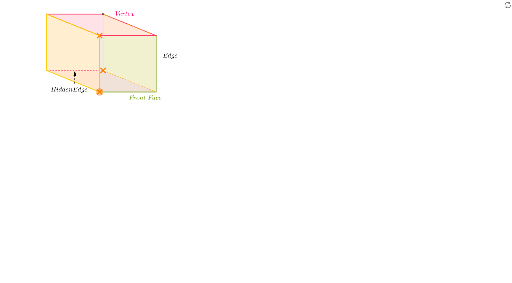
This example demonstrates the fundamental components and properties of prisms and pyramids in geometry. It involves core math concepts such as solid geometry, polygons, vector operations, and relationships between points and lines. GeoGebra commands and objects used in construction include Intersect, OrthogonalLine, Point, Polygon, Vector, and Midpoint. Suitable for high school students to understand the structure and characteristics of three-dimensional shapes, and for supplementary teaching in related math courses.
GeoGebra Commands & Parameters
Intersect(xAxis, yAxis) → AOrthogonalLine(A, yAxis) → aPoint(a) → BOrthogonalLine(B, xAxis) → bPoint(b) → CPolygon(A, B, C, D) → poly1, a_1, b_1, c, dPolygon(E, F, G, H) → poly2, e, f, g, hPolygon(D, C, G, H) → poly3, d_1, c_1, g_1, h_1Polygon(A, E, F, B) → poly4, a_2, e_1, f_1, b_2Polygon(B, F, G, C) → poly5, b_3, f_2, g_2, c_2Polygon(A, E, H, D) → poly6, a_3, e_2, h_2, d_2Vector(Midpoint[A, D] + (1 / 10 * (Vector[B, C] + Vector[B, A])), Midpoint[A, D]) → uVector(Midpoint[A, B] - (1 / 5 * Vector[A, D]), Midpoint[A, C]) → vVector(H - (1 / 4 * Vector[H, C]), H) → wMidpoint(E, F) → IVector(J, I) → z
AI Drawing Prompt Reference
Draw a prism and a pyramid with their bases and sides. Start by drawing the four vertices of the base ABCD, then draw the four vertices of the side EFGH. Next, draw the base polygon ABCD of the prism and the base polygon EFGH of the pyramid, as well as the side polygons connecting them. Finally, draw the side edges of the prism and pyramid.
The prompt above was compiled from the original drawing commands and is for reference only.