
Partial Fraction Decomposition with Quadratic & Linear Factors
Loading the math board and drawing, please wait…
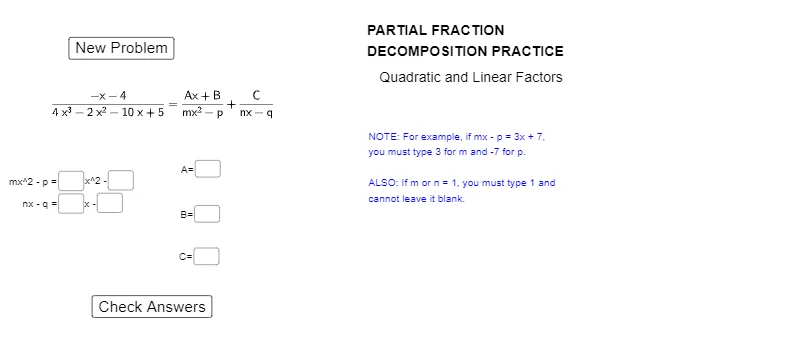
This example demonstrates how to decompose a rational function into partial fractions when the denominator contains both linear and quadratic factors. It helps learners visualize the standard decomposition forms and verify the resulting coefficients under randomly generated parameters. The underlying math concepts include rational functions, partial fraction decomposition, linear vs. irreducible quadratic factors, coefficient determination (via algebraic construction/implicit solving), and real-time expression building. Construction uses GeoGebra commands such as Random and RandomDiscrete for parameter generation, If and Textfield for conditional logic and interactive parameter display, Polynomial for building the algebraic numerator/denominator polynomials, and Max/Min together with multiple InputBox objects to constrain and update values. Key objects include the generated coefficients and checks like mguess/nguess and correctness flags (e.g., correctA), with buttons (button1/button2) to trigger computation and validation. Suitable for high school and early undergraduate math courses, especially for teaching rational function manipulation before applications in calculus or differential equations.
GeoGebra Commands & Parameters
Random(-9, 11) → a_{1}Random(-10, 10) → fRandomDiscrete({-3, -2, -1, 0, 1, 2, 3, 4, 5, 6, 7, 8}, {2, 2, 4, 16, 4, 4, 4, 2, 2, 1, 1, 1}) → dRandom(-9, 11) → bRandomDiscrete({1, 2, 3}, {8, 4, 2}) → mIf(GCD[a_{1}, m] ≟ 1, a_{1}, RandomElement[{-1, 1, 5, -5}]) → aRandomDiscrete({1, 2, 3, 5}, {8, 5, 3, 1}) → kIf(GCD[n, b] ≟ 1, b, 1) → cIf(d ≟ 0, f, (d * x) + f) → hPolynomial((((m * x^(2)) - a) * ((n * x) - c))) → gTextfield(p) → InputBox1Textfield(q) → InputBox2Textfield(A) → InputBox3Textfield(B) → InputBox4Textfield(mguess) → InputBox5Textfield(nguess) → InputBox6Textfield(C) → InputBox7Max({a, c}) → maxPMin({a, c}) → maxQ
AI Drawing Prompt Reference
Draw a rational function with a denominator containing linear and irreducible quadratic factors. First, randomly generate parameters a₁, f, d, b, m, k, and c, then construct the rational function with denominator (d*x+f) and ((m*x^2-a)*(n*x-c)). Use InputBox1 and InputBox2 to input the linear term coefficient p and constant term q of the numerator, and use InputBox3 and InputBox4 to input the coefficients of the linear factor a and the irreducible quadratic factor c. Use InputBox5 and InputBox6 to input the linear coefficient mguess and constant term nguess of the numerator, and use InputBox7 to input the verification coefficient C. Finally, display the maximum value maxP and minimum value maxQ.
The prompt above was compiled from the original drawing commands and is for reference only.