
Parallelogram Measurements by Renee Collingwood
Loading the math board and drawing, please wait…
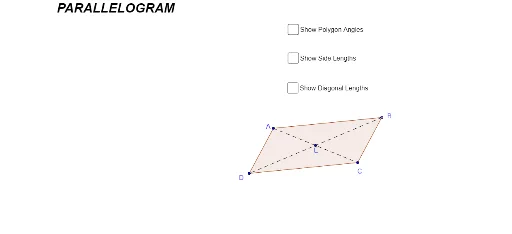
This example demonstrates the relationships between the sides, angles, and diagonals of a parallelogram. Key math concepts include parallelogram properties, angle measurement, distance calculation, and coordinate geometry. Constructed using commands like Line, Point, Intersect, Polygon, Angle, Distance, Segment in GeoGebra, suitable for middle school and above learning geometric properties and coordinate geometry applications.
GeoGebra Commands & Parameters
Line(l, A) → aLine(C, a) → bPoint(b) → BLine(A, B) → cLine(C, c) → dIntersect(a, d) → DPolygon(D, A, B, C) → poly1, e, b_1, d_1, c_1Angle(D, A, B) → αAngle(A, B, C) → βAngle(B, C, D) → γAngle(C, D, A) → δDistance(A, B) → distanceABDistance(B, C) → distanceBCDistance(C, D) → distanceCDDistance(D, A) → distanceDASegment(A, C) → fSegment(B, D) → gDistance(A, C) → distanceACDistance(D, B) → distanceDBIntersect(f, g) → EDistance(A, E) → distanceAEDistance(E, C) → distanceECDistance(D, E) → distanceDEDistance(E, B) → distanceEBAngle(A, E, D) → εAngle(B, E, A) → ζAngle(C, E, B) → ηAngle(D, E, C) → θAngle(E, A, B) → ιAngle(A, B, E) → κAngle(E, B, C) → λAngle(E, C, D) → μAngle(C, D, E) → νAngle(E, D, A) → ξAngle(B, C, E) → οAngle(D, A, E) → ρ
AI Drawing Prompt Reference
Draw a parallelogram. Start with a horizontal line, then a slanted line through a point on it. Through a point on the slanted line, draw a line parallel to the horizontal one, and connect the intersections to form the parallelogram. Label the four vertices. Measure and display the lengths of all four sides. Draw both diagonalscars, measure their lengths, and mark their intersection point. Measure the distances from this intersection to each vertex. Finally, label and display the four interior angles, the four angles formed by the diagonals at the intersection, and the eight angles formed between the diagonals and the sides.
The prompt above was compiled from the original drawing commands and is for reference only.