
Parallelogram Investigation by mtorres1
Loading the math board and drawing, please wait…
In collections
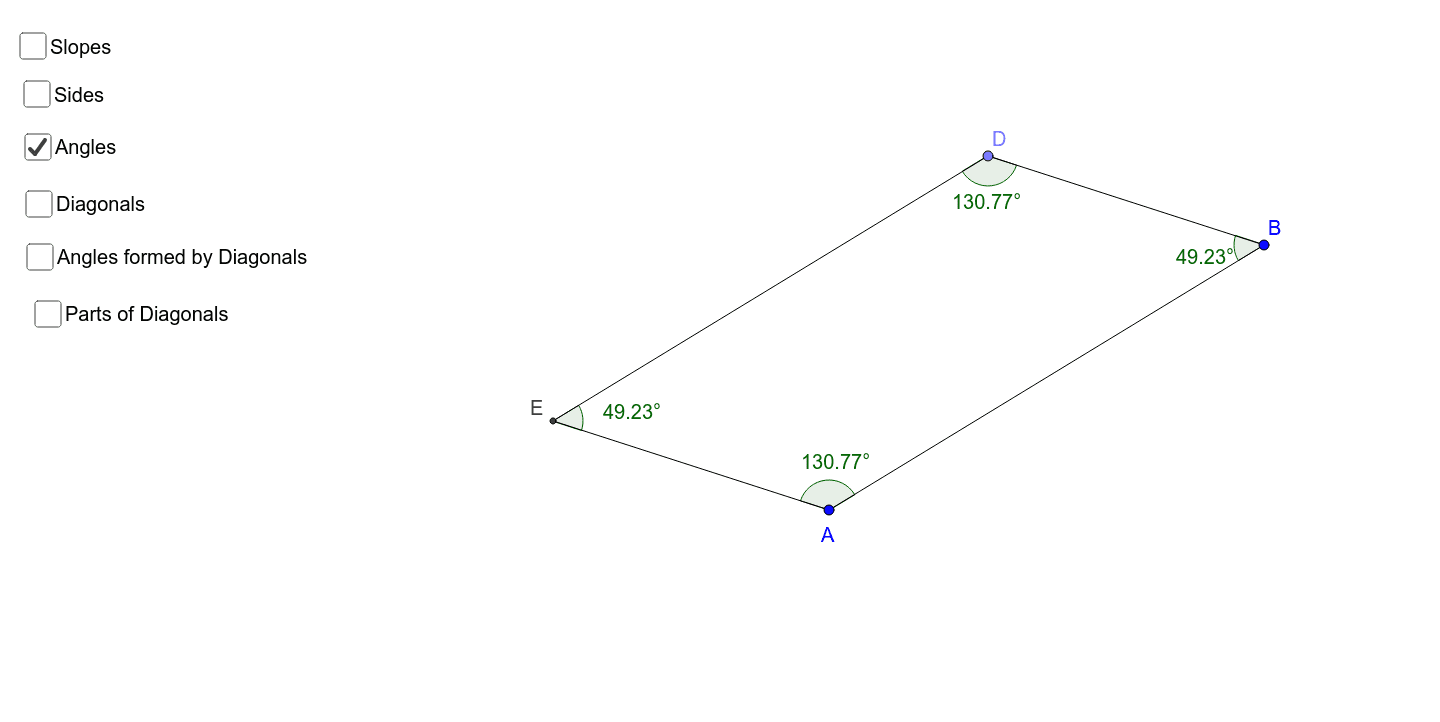
Investigating Parallelogram Sides and Angles
This example demonstrates the properties and exploration of a parallelogram. Key mathematical concepts include the definition and properties of a parallelogram, as well as similarity transformations. Using GeoGebra commands such as Segment, Line, and Point, a dynamic parallelogram can be constructed and its geometric features observed. Suitable for middle school and above students or teachers.
GeoGebra Commands & Parameters
Segment(A, B) → aLine(C, a) → bPoint(b) → DSegment(B, D) → cLine(A, c) → dIntersect(b, d) → ESegment(A, E) → eSegment(E, D) → fSlope(f) → mSlope(a) → m_1Slope(e) → m_2Slope(c) → m_3Distance(E, A) → distanceEADistance(A, B) → distanceABDistance(B, D) → distanceBDDistance(D, E) → distanceDEAngle(B, A, E) → αAngle(A, E, D) → βAngle(E, D, B) → γAngle(D, B, A) → δSegment(E, B) → jSegment(D, A) → kIntersect(j, k) → FAngle(E, F, A) → εAngle(A, F, B) → ζAngle(B, F, D) → ηAngle(D, F, E) → θAngle(E, D, F) → ιAngle(F, E, D) → κAngle(D, B, F) → λAngle(F, D, B) → μAngle(F, B, A) → νAngle(B, A, F) → ξAngle(F, A, E) → οAngle(A, E, F) → ρDistance(E, F) → distanceEFDistance(F, B) → distanceFBDistance(D, F) → distanceDFDistance(F, A) → distanceFA