
Parallelogram Exploration by Dan Buker
Loading the math board and drawing, please wait…
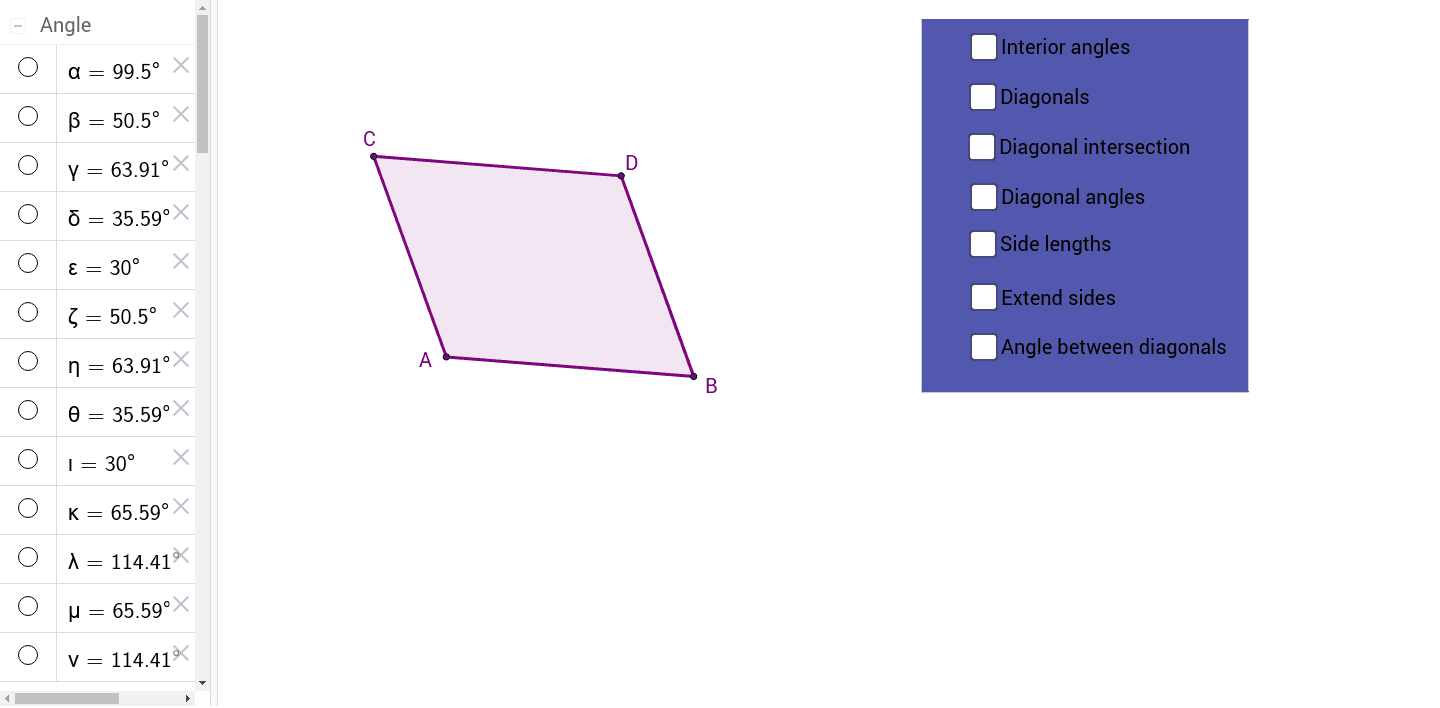
This example demonstrates the properties and explorations of parallelograms. Key mathematical concepts include the definition and properties of parallelograms, as well as the relationships between angles and segments. Using GeoGebra commands such as Line, Intersect, Polygon, Segment, etc., one can construct and analyze parallelograms. Suitable for middle school and above students and teachers to understand and teach geometric knowledge.
GeoGebra Commands & Parameters
Line(A, B) → aLine(C, a) → bLine(A, C) → cLine(B, c) → dIntersect(b, d) → DPolygon(C, A, B, D) → poly1, c_1, a_1, b_1, d_1Segment(A, D) → ADSegment(C, B) → CBSegment(C, D) → CDSegment(D, B) → DBSegment(B, A) → BASegment(A, C) → ACSegment(D, A) → gSegment(C, B) → hAngle(g, h) → αSegment(A, D) → jSegment(C, B) → kAngle(B, A, D) → βAngle(D, A, C) → γAngle(A, C, B) → δAngle(B, C, D) → εAngle(C, D, A) → ζAngle(A, D, B) → ηAngle(D, B, C) → θAngle(C, B, A) → ιIntersect(j, k) → ESegment(E, C) → ECSegment(E, D) → EDSegment(E, B) → EBSegment(E, A) → EALine(C, A) → nLine(A, B) → pLine(B, D) → qLine(D, C) → rPolygon(F, G, H, I) → poly2, f_1, g_1, h_1, i_1Angle(poly1) → κ, λ, μ, ν
AI Drawing Prompt Reference
Draw a parallelogram to demonstrate its properties, including parallel and equal opposite sides, and bisecting diagonals. Start by creating two parallel lines, then construct the parallelogram using intersection points. Label all sides and angles, analyze the triangles formed by the intersection of diagonals, measure and mark key angles, and differentiate major geometric elements with colors or styles to clearly show the properties and relationships of the parallelogram.
The prompt above was compiled from the original drawing commands and is for reference only.