
Parallelogram Diagonal Properties (Bilingual Interactive)
Loading the math board and drawing, please wait…
In collections
Quadrilaterals الرُباعيات
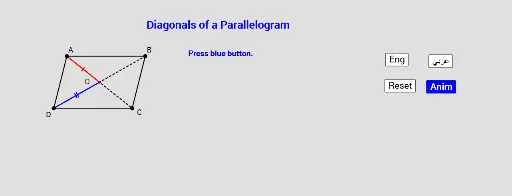
This GeoGebra example demonstrates the property that the diagonals of a parallelogram bisect each other, with an interactive bilingual interface in Arabic and English. The core mathematical concept is the diagonal property of parallelograms: the diagonals intersect at their common midpoint, dividing the parallelogram into four triangles of equal area. The construction uses the Segment tool to draw the sides, the Intersect command to find the diagonal intersection point O, and the Rotate command to create symmetric copies. Buttons (button1, button2) allow toggling between English and Arabic labels. Suitable for middle school geometry lessons or self-study, this example helps students visualize the diagonal bisection property and serves as a resource for bilingual mathematics classrooms.
GeoGebra Commands & Parameters
Segment(A, B) → fSegment(B, C) → gSegment(C, D) → hSegment(D, A) → iSegment(A, C) → jSegment(D, B) → kIntersect(j, k) → OSegment(O, B) → lSegment(O, D) → mSegment(O, C) → nSegment(O, A) → pRotate(O, 180°, O) → O'Rotate(A, 180°, O) → A'Rotate(O, 180°, O) → O'_1Rotate(A, 180°, O) → A'_1Rotate(O, ((a * 180))°, O) → O'_2Rotate(A, ((a * 180))°, O) → A'_2Segment(O'_2, A'_2) → p'Rotate(O, ((a * 180))°, O) → O'_3Rotate(D, ((b * 180))°, O) → D'Segment(O'_3, D') → m'
AI Drawing Prompt Reference
Draw a parallelogram with four vertices. Connect the two diagonals, which intersect at a central point that bisects each diagonal. From this center, draw segments to all four vertices, creating four triangles. Then rotate one vertex and the center by 180 degrees around the center, and connect the rotated center to the rotated vertex to form a segment parallel to a diagonal. Similarly, rotate another vertex and the center by 180 degrees, and connect the rotated points to form another symmetric segment. The figure illustrates that the diagonals bisect each other and divide the parallelogram into four equal-area triangles.
The prompt above was compiled from the original drawing commands and is for reference only.