
Parallelogram Diagonal Intersection Ratios
Loading the math board and drawing, please wait…
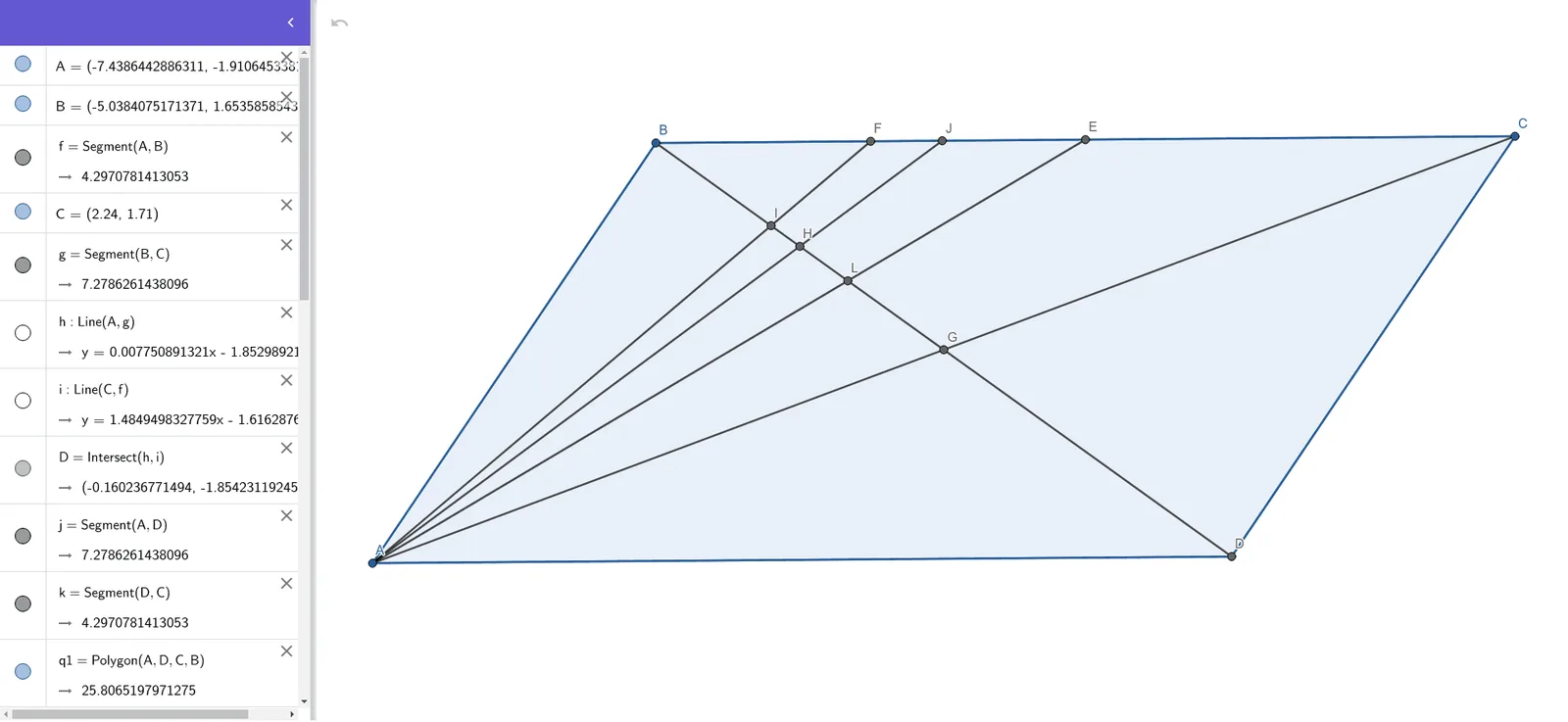
This GeoGebra example dynamically demonstrates the ratio of the two segments created when the diagonals of a parallelogram intersect, showing that the intersection point divides each diagonal into equal halves, i.e., the diagonals bisect each other. Core mathematical concepts include properties of parallelogram diagonals, segment ratios, congruent triangles, and midpoint definition. Construction highlights: using Segment and Line to build the parallelogram sides and diagonals, Intersect to find the diagonal intersection, Polygon and Midpoint to create auxiliary shapes and midpoints, with multiple points, segments, and lines (A, B, C, D, E, F, G, H, I, L, J) and parameters (q1, a, d, c, b, p, q) for dynamic adjustment and measurement. Suitable for middle school geometry or introductory high school analytic geometry, this interactive tool helps students verify that the ratio is always 1:1 and grasp an intuitive proof of the theorem.
GeoGebra Commands & Parameters
Segment(A, B) → fSegment(B, C) → gLine(A, g) → hLine(C, f) → iIntersect(h, i) → DSegment(A, D) → jSegment(D, C) → kPolygon(A, D, C, B) → q1, a, d, c, bMidpoint(B, C) → EMidpoint(B, E) → FSegment(B, D) → lSegment(A, E) → mSegment(A, F) → nMidpoint(B, D) → GMidpoint(B, G) → HIntersect(n, l) → IIntersect(l, m) → LIntersect(Line[A, H], g) → JSegment(A, J) → pSegment(A, C) → q