
Parallelogram Construction by Jim Moser
Loading the math board and drawing, please wait…
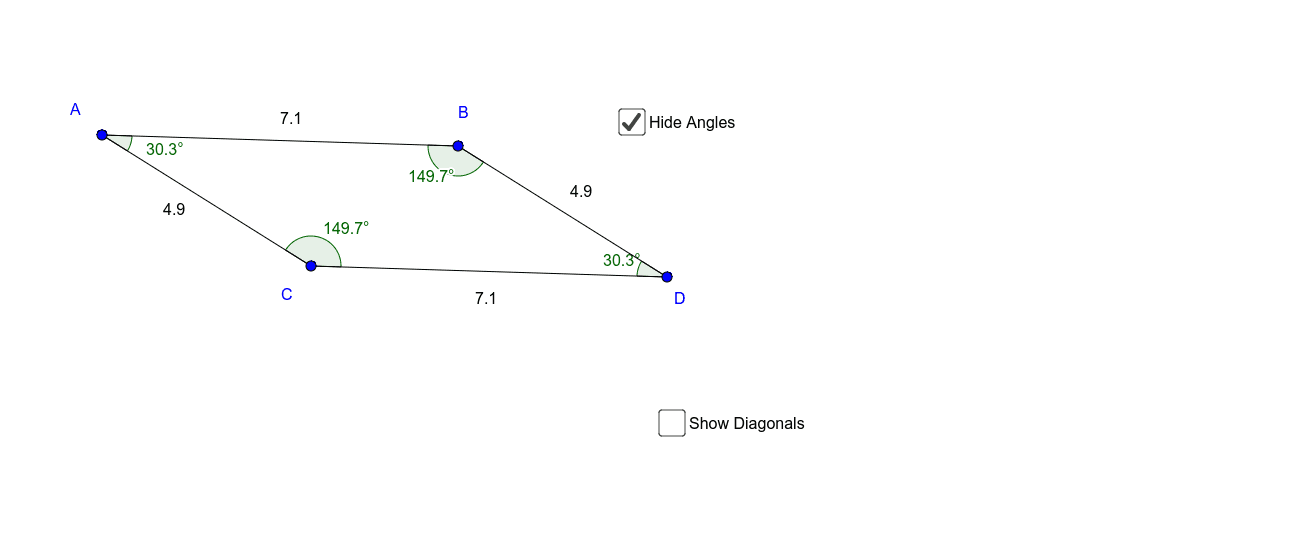
This example demonstrates the geometric properties of a parallelogram. Key mathematical concepts include the definition and properties of a parallelogram, as well as angle relationships. Using GeoGebra commands such as Line, Intersect, and Segment, a dynamic parallelogram can be constructed and its side lengths and angles can be observed. Suitable for middle school and above students and teachers.
GeoGebra Commands & Parameters
Line(A, B) → fLine(A, C) → gLine(C, f) → hLine(B, g) → iIntersect(h, i) → DSegment(A, C) → jSegment(C, D) → kSegment(D, B) → lSegment(B, A) → mAngle(C, A, B) → αAngle(D, C, A) → βAngle(B, D, C) → γAngle(A, B, D) → δSegment(A, D) → nSegment(C, B) → pIntersect(n, p) → ESegment(A, E) → qSegment(E, B) → rSegment(E, C) → sSegment(E, D) → tAngle(B, E, A) → ε