
Parallelogram Area Demonstration by Mark Dabbs
Loading the math board and drawing, please wait…
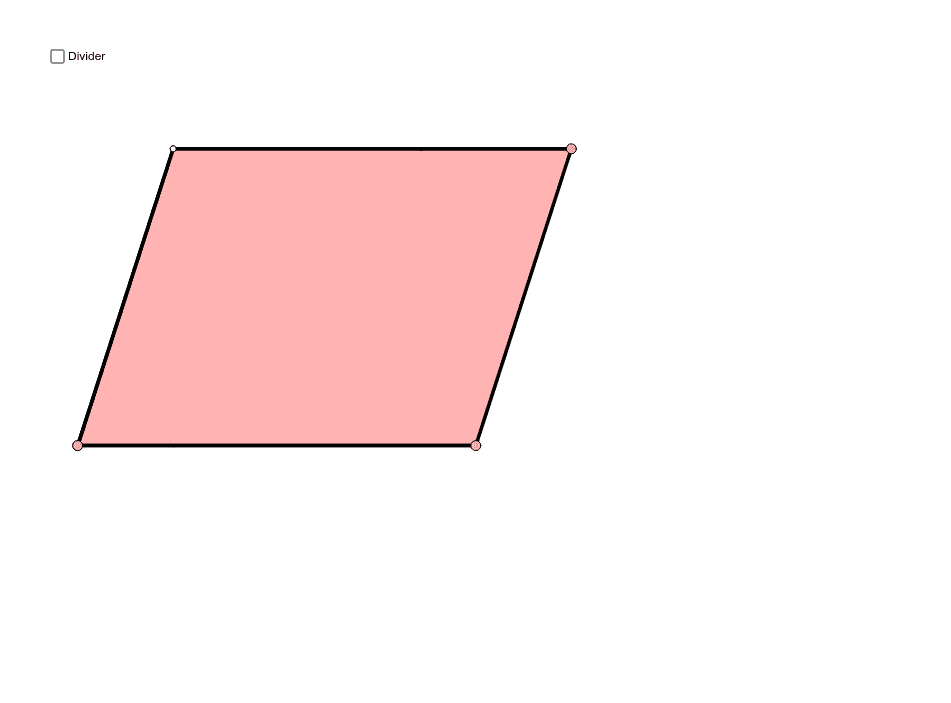
This example visually demonstrates the calculation of a parallelogram's area by showing the base times height. Core math concepts include parallelograms, area formulas, similar triangles, and coordinate geometry. Construction involves GeoGebra commands like Point, OrthogonalLine, Segment, Line, Intersect, Polygon, Dilate, Circle, and objects such as Translate, g, A, a, C, B_1, b, c, d, D_1, e, f, h, i, j, B, D, k, E, l, m, n, F, p, poly1, a_1, e_1, f_1, d_1, poly2, e_2, c_1, b_1, f_2, q, r, s, C', t, g_1. Suitable for middle school students and above learning parallelogram area formulas and geometric constructions.
GeoGebra Commands & Parameters
Point(g) → AOrthogonalLine(A, g) → aPoint(g) → CSegment(C, B_1) → bLine(A, b) → cLine(B_1, g) → dIntersect(c, d) → D_1Segment(D_1, B_1) → eSegment(A, D_1) → fOrthogonalLine(C, g) → hOrthogonalLine(D_1, g) → iOrthogonalLine(B_1, g) → jIntersect(g, i) → BIntersect(g, j) → DSegment(If[x(B) ≥ x(A), B, A], If[x(B) ≥ x(A), C, D]) → kPoint(k) → ESegment(A, B) → lSegment(C, D) → mOrthogonalLine(E, e) → nIntersect(n, e) → FSegment(F, E) → pPolygon(A, E, F, D_1) → poly1, a_1, e_1, f_1, d_1Polygon(E, C, B_1, F) → poly2, e_2, c_1, b_1, f_2Segment(B_1, F) → qSegment(F, D_1) → rSegment(A, C) → sDilate(C, Translate, A) → C'Line(C', b) → tLine(B_1, s) → g_1Intersect(t, g_1) → GCircle(G, Segment[D_1, F]) → h_1Circle(C', Segment[A, E]) → k_1Line(A, C) → i_1Intersect(k_1, i_1) → H, IIntersect(h_1, g_1) → J, KSegment(B_1, K) → j_1Segment(K, I) → l_1Segment(I, C') → m_1Segment(G, C') → n_1Polygon(C', G, K, I) → poly3, c', g_2, k_2, i_2Segment(E, C) → p_1Segment(G, F) → q_1Segment(F, E) → r_1Segment(I, K) → s_1