
Parallel Lines & Transversal: Alternate Interior Angles Investigation
Loading the math board and drawing, please wait…
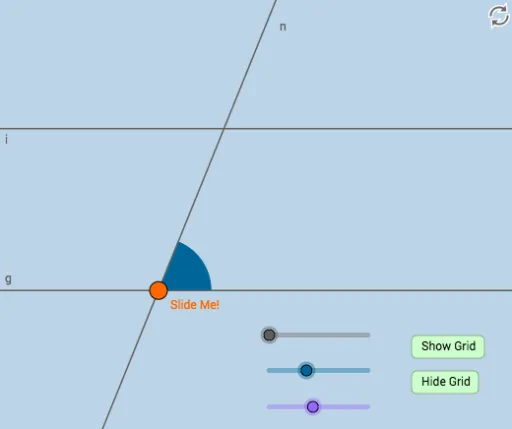
This example demonstrates the relationship between alternate interior angles formed when a transversal intersects parallel lines. Key math concepts include properties of parallel lines, alternate interior angles, corresponding angles, and vertical angles. It is constructed using GeoGebra commands like Point, Line, Rotate, Angle, Circle, Intersect, Segment, CircleSector, Vector, Translate, Ray, and CircleArc. Suitable for middle school students and above to explore geometric properties and spatial relationships.
GeoGebra Commands & Parameters
Point(y = 0) → ALine(A, B) → fRotate(B, α, A) → B'Angle(B, A, B') → γLine(A, B') → gRotate(B', β, A) → B''Angle(B', A, B'') → δLine(A, B'') → hCircle(A, a) → cIntersect(c, h, 2) → CLine(C, g) → iCircle(C, A) → dCircle(A, C) → eIntersect(e, h, 2) → JSegment(A, C) → jCircle(A, (0.3 * j)) → kCircle(C, (0.3 * j)) → pIntersect(p, h) → N, OIntersect(k, h) → P, QIntersect(k, g) → T, UIntersect(p, i, 2) → VIntersect(p, i, 1) → WCircleSector(A, U, Q) → qCircle(C, j / 2) → g_1Circle(A, j / 2) → h_1Intersect(g_1, i, 2) → DIntersect(g_1, i, 1) → EIntersect(g_1, h, 2) → HIntersect(g_1, h) → I, ZIntersect(h_1, h) → A_1, B_1Intersect(h_1, g) → E_1, F_1Point(j) → G_1Vector(A, G_1) → uTranslate(q, u) → q'Segment(A, G_1) → lRay(A, A_1) → mRay(C, H) → nVector(A, G_1) → vSegment(G_1, C) → sCircleArc(A, U, Q) → tCircleArc(C, N, O) → rPoint(r) → FRotate(F, (-δ), C) → F'Angle(F', C, F) → εCircleSector(C, F', F) → c_1Segment(A, C) → b
AI Drawing Prompt Reference
Draw a horizontal line with a point on it as the vertex. From this vertex, create two rays in different directions, forming three adjacent angles. Construct a circle centered at the vertex intersecting one ray, then draw a line through that intersection parallel to the other ray. Using the intersection and vertex as centers, draw circles and use their intersections to create arcs and sectors. Translate one sector along a segment. Finally, draw two rays from the vertex and the intersection to points on their respective circles, and rotate an angle to show the alternate interior angle relationship.
The prompt above was compiled from the original drawing commands and is for reference only.