
Parallel Lines & Related Angles Discovery
Loading the math board and drawing, please wait…
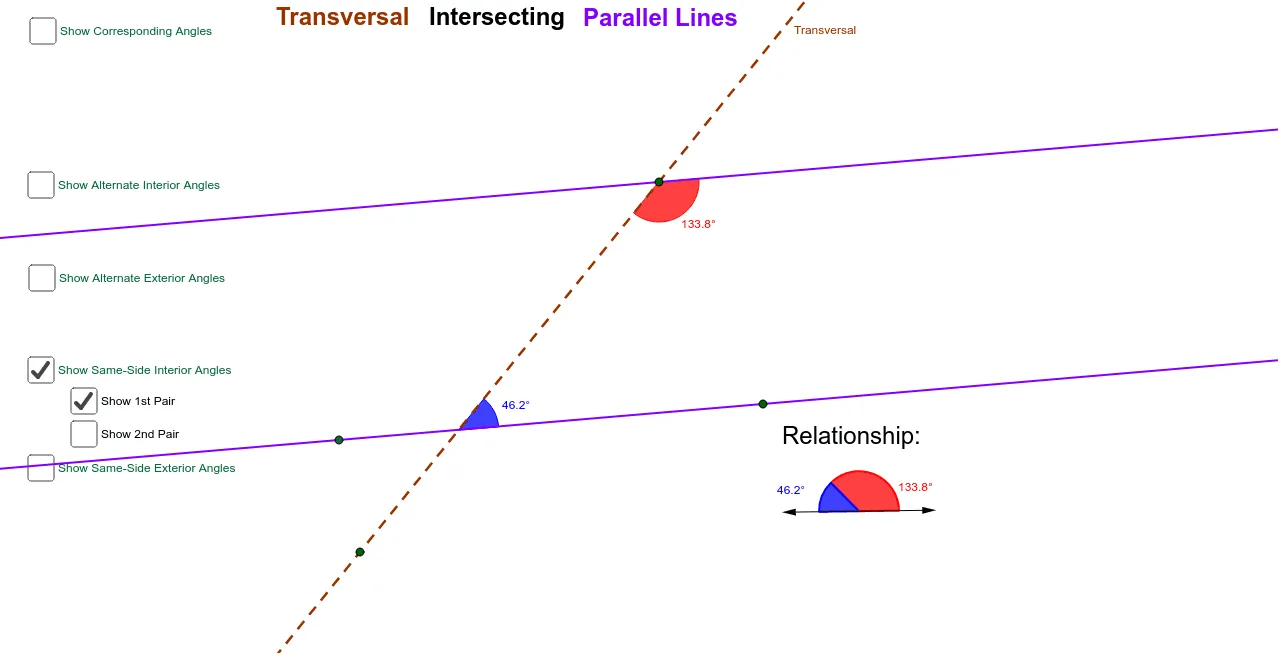
① This applet demonstrates the angle-pair relationships formed when a transversal crosses two parallel lines, such as corresponding, alternate interior, alternate exterior, and consecutive interior angles. ② Core concepts include parallel lines, transversal, angle pairs, angle equality, and supplementary angles. ③ Construction uses GeoGebra commands: Line, Intersect, Angle, Point, Rotate, Circle, Vector, with objects A, B, a, E, F, c, K, η, θ, d–t, α, β, C, G, H, γ–μ. ④ Designed for middle school geometry students or teachers, it supports inquiry-based learning by dragging the transversal or lines to observe angle changes and verify the parallel line angle theorems.
GeoGebra Commands & Parameters
Line(A, B) → aLine(E, F) → cIntersect(a, c) → KAngle(A, K, F) → ηAngle(F, K, B) → θLine(E, a) → bAngle(B, K, E) → αAngle(E, K, A) → βPoint(c) → CPoint(b) → GPoint(b) → HAngle(H, E, C) → γAngle(C, E, G) → δAngle(G, E, K) → εAngle(K, E, H) → ζAngle(K, E, H) → ιAngle(G, E, K) → κAngle(B, K, E) → λAngle(E, K, A) → μAngle(H, E, C) → νAngle(C, E, G) → ξAngle(A, K, F) → οAngle(F, K, B) → ρAngle(H, E, C) → σAngle(C, E, G) → τAngle(G, E, K) → υAngle(K, E, H) → ϕAngle(B, K, E) → χAngle(E, K, A) → ψAngle(A, K, F) → ωAngle(F, K, B) → α_1Line(D, I) → a_1Point(a_1) → JRotate(I, ϕ, J) → I'Angle(I, J, I') → β_1Rotate(I', χ, J) → I''Angle(I', J, I'') → γ_1Circle(J, 2) → c_1Intersect(c_1, a_1, 1) → MIntersect(c_1, a_1, 2) → NVector(J, N) → uVector(J, M) → vLine(O, P) → b_1Point(b_1) → QRotate(P, ϕ, Q) → P'Angle(P, Q, P') → δ_1Rotate(P', χ, Q) → P''Angle(P', Q, P'') → ε_1Circle(Q, 2) → d_1Intersect(d_1, b_1, 1) → RIntersect(d_1, b_1, 2) → SVector(Q, S) → wVector(Q, R) → u_1
AI Drawing Prompt Reference
Draw two parallel horizontal lines intersected by a slanted transversal line, creating multiple intersection points. At each intersection, label all angles formed by adjacent rays, using distinct colors or symbols to differentiate corresponding angles, alternate interior angles, alternate exterior angles, and consecutive interior angles. Additionally, construct an auxiliary circle on one side, place two points on it, and use rotation to replicate angles equal to those in the main figure, visually demonstrating angle equality. The overall diagram should clearly show the positions and sizes of all angles formed by the parallel lines and transversal, facilitating observation and verification of parallel-line angle theorems.
The prompt above was compiled from the original drawing commands and is for reference only.