
Parallel Lines and Angles by Jorge Cássio
Loading the math board and drawing, please wait…
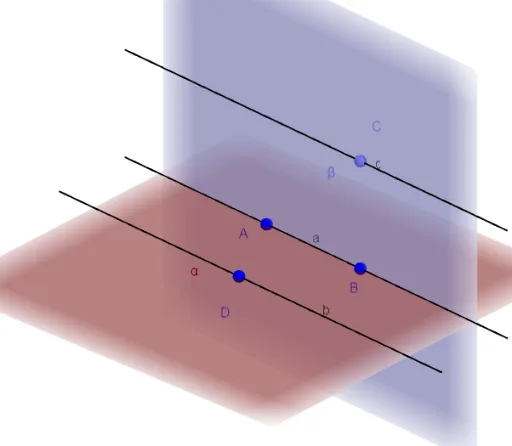
This example demonstrates the relationships between alternate interior, corresponding, and consecutive angles formed by parallel lines intersected by a transversal. Key math concepts include properties of parallel lines, transversals, alternate interior angles, corresponding angles, and consecutive interior angles. It is constructed using GeoGebra commands and objects such as Line, Plane, OrthogonalLine, Point, and Angle. Suitable for middle school students and above to learn and understand geometric angle relationships, ideal for classroom instruction or self-study.
GeoGebra Commands & Parameters
Line(A, B) → aLine(D, a) → bPlane(D, B, A) → c_1Plane(D, B, A) → αOrthogonalLine(B, α) → fPoint(f) → CPlane(B, A, C) → βLine(C, a) → cOrthogonalLine(A, a) → hAngle(a, h) → α_1Angle(b, h) → β_1Angle(f, a) → γAngle(f, c) → δOrthogonalLine(D, c, space) → iAngle(i, c) → εAngle(b, i) → ζ
AI Drawing Prompt Reference
Draw two parallel horizontal lines. Add a transversal line crossing both parallels at an angle. Pick a point on the transversal and draw a line perpendicular to it through that point, then place a point on this perpendicular and connect it to the parallels to form a new line. From a point on one parallel, draw a perpendicular to that parallel. Finally, mark the angles formed by these intersections, including corresponding, alternate interior, and consecutive interior angles, and display their measures.
The prompt above was compiled from the original drawing commands and is for reference only.