
Parabolic Waves
Loading the math board and drawing, please wait…
In collections
surface 3D /3D-Oberflächen 1
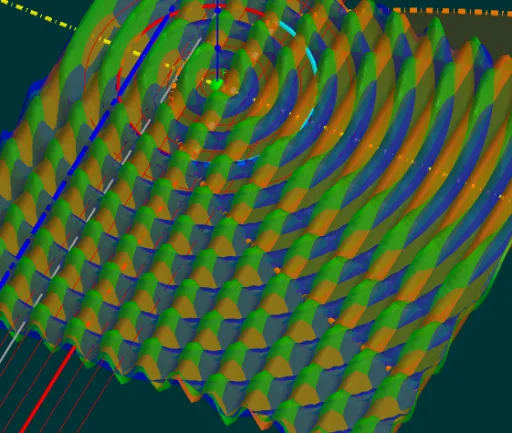
This example demonstrates the generation of parabolic waves. Key mathematical concepts include parabolas, geometric transformations, and integrals. Using GeoGebra commands such as Point, Parabola, Tangent, and Mirror, the example dynamically illustrates the properties of parabolas and their application in wave patterns. Suitable for high school mathematics education and learning.
GeoGebra Commands & Parameters
Point(xAxis) → AOrthogonalLine(A, xAxis) → fParabola(F, f) → cPoint(c) → STangent(S, c) → g,Mirror(K_s, g) → G_sCircle(F, K_s) → dOrthogonalLine(G_s, xAxis) → hSequence((2 * fractionalPart(τ + k / Anzahl)), k, 0, (2 * Anzahl)) → ListτkZip(((u * x(A)), 0), u, Listτk) → ListKPkteZip(Circle[F, P], P, ListKPkte) → ListKreiseZip(Mirror[P, g], P, ListKPkte) → ListGPkteLine(A, F) → iZip(OrthogonalLine[P, i], P, ListGPkte) → ListGeradenIntersect(d, h) → B, CPoint(d) → DSegment(C, B) → jCircumcircleArc(B, D, C) → pLine(F, A) → lIntegralBetween(sqrt(((2 * abs(x(A))) * (x - x(S)))), (-sqrt(((2 * abs(x(A))) * (x - x(S))))), x(S), 10, false) → a
AI Drawing Prompt Reference
Draw a parabolic wave pattern, demonstrating parabolas, geometric transformations, and integrals. Start by sketching a parabola, then apply transformations to create reflections and tangents. Use a slider to generate a series of circles and points, and reflect these, along with drawing related lines and arcs, to complete the wave effect.
The prompt above was compiled from the original drawing commands and is for reference only.