
Parabola Vertex Form: Exploring Parameter Transformations
Loading the math board and drawing, please wait…
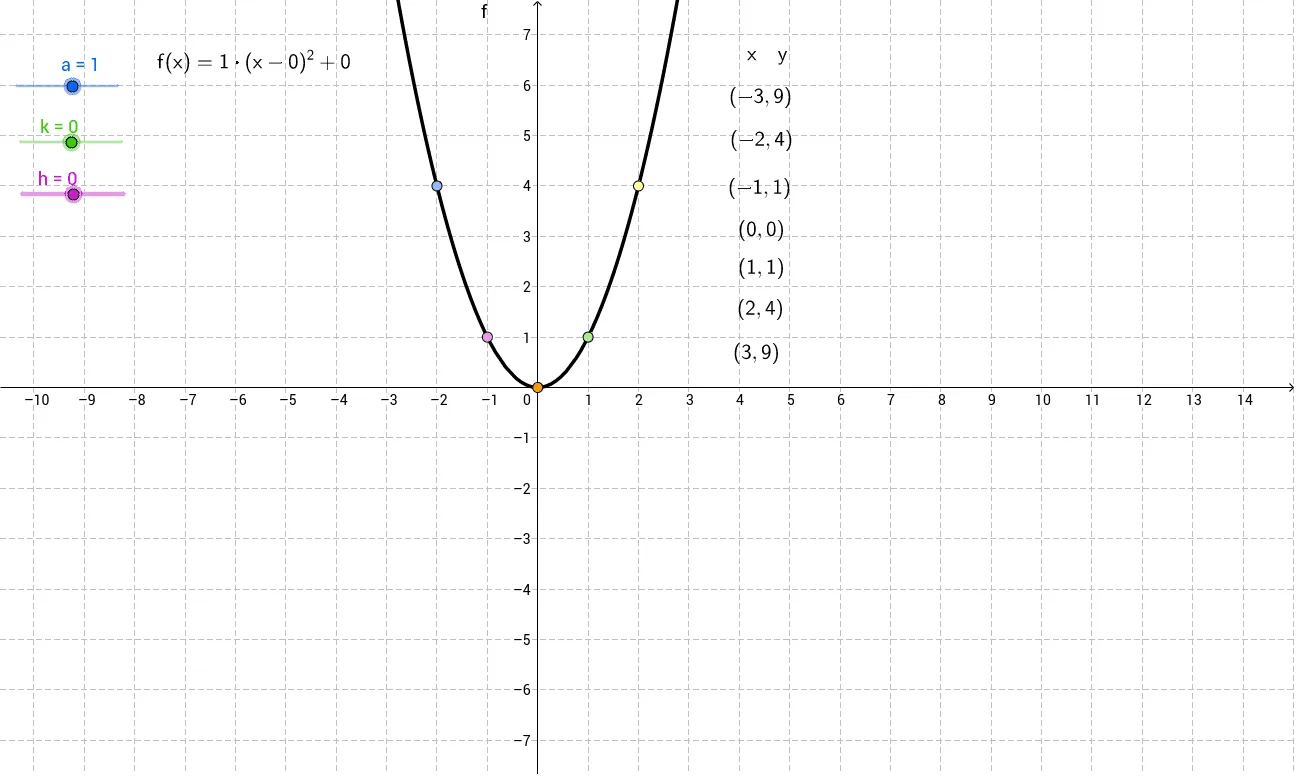
① This interactive GeoGebra example demonstrates how the parameters a, h, and k in the vertex form of a parabola y = a(x - h)² + k affect its graph, including horizontal/vertical shifts, vertical stretch/compression, and reflection. ② Core mathematical concepts include quadratic functions, vertex form, transformations (translation, scaling, reflection), and the relationship between algebraic equations and geometric graphs. ③ Construction highlights: sliders for a, h, and k are used to define the function f(x) = a*(x - h)^2 + k; the graph is plotted, and auxiliary points such as the vertex, focus, and directrix are constructed (objects like C, D, E, etc.), with a table (tableheading) displaying key coordinates to visualize how parameters affect the geometry. ④ Suitable for middle school to high school students, this example serves as an exploratory tool for learning quadratic function transformations, and as a classroom demonstration aid for teachers to illustrate the geometric meaning of the vertex form.
GeoGebra Commands & Parameters
Numeric k(0.0)Numeric a(1.0)Point A(7.5, 5.82)Point B(7.5, 1.56)Numeric h(0.0)f(x) = a * (x - h)^(2) + k(h, f(h))(h + 1, f(h + 1))(h + 2, f(h + 2))(h + 3, f(h + 3))(h - 1, f(h - 1))(h - 2, f(h - 2))(h - 3, f(h - 3))