
Parabola Transformation: Parameter-Driven Dynamic Geometry
Loading the math board and drawing, please wait…
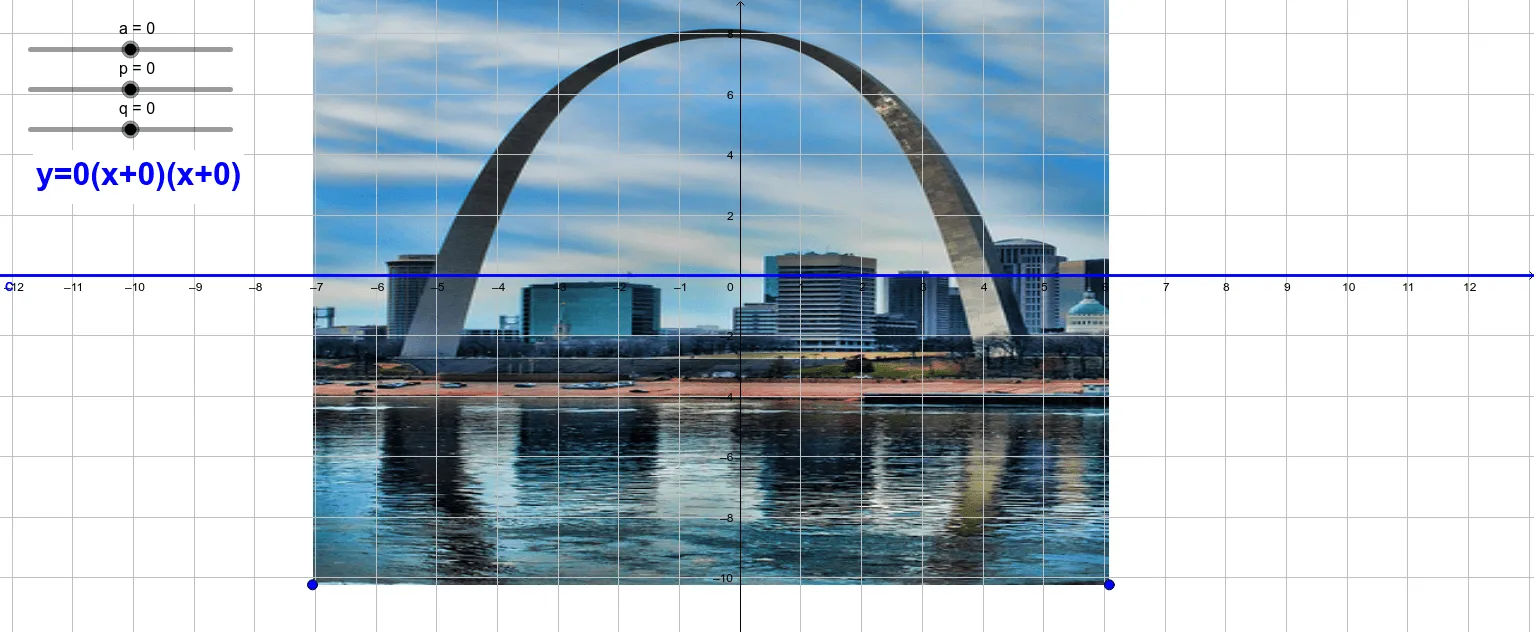
①This GeoGebra example dynamically illustrates how a parabola y=a(x-p)²+q changes with parameters a, p, and q, showing translations, scaling, and opening direction, while linking to isosceles triangles, distributions, bar charts, arithmetic operations, and matrices. ②Core concepts include quadratic functions, parameter effects on shape and position, geometric transformations (translation and scaling), and connections between algebraic, geometric, and statistical representations. ③Construction uses sliders for parameters a, p, q, creating the parabola object a, points A, B, C, D, E (possibly forming isosceles triangles), text1 for labels, pic1 for images, and matrix objects for transformation matrices. ④Suitable for high school or early college students to understand quadratic transformations, parametric exploration, and interdisciplinary math modeling.
GeoGebra Commands & Parameters
Numeric a(0)Numeric p(0)Numeric q(0)y = ((a * (x + p)) * (x + q))Point A(1, 0)Point B(1.764, -3.768)Point C(8.404, -3.768)Point D(-7.050670034721526, -10.234579763663223)Point E(6.081727818297349, -10.234579763663223)