
Parabola Sketching with Isosceles Triangles via Geometric Construction
Loading the math board and drawing, please wait…
In collections
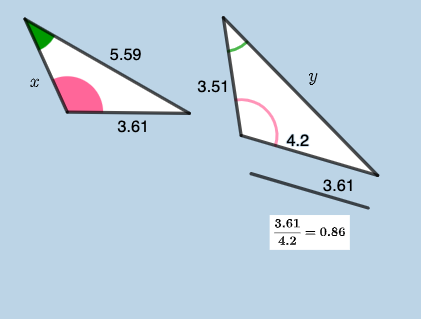
Exploration: Similar Triangles
This example (“Task 3”) demonstrates how to construct and sketch a parabola-related curve using interactive geometric constructions. It combines isosceles-triangle symmetry/angle relationships with circle and arc constraints to produce the desired curve. Key concepts include quadratic-curve (parabola) construction or geometric characterization, isosceles triangle properties, circle/arc intersection geometry, and transformation-based construction (rotation, translation, dilation) guided by vectors and angles. From the GeoGebra construction commands, it uses Segment, Rotate, Ray, Point, OrthogonalLine, Circle, Intersect, Line, Polygon, Min, CircleSector, Dilate, Vector, Translate, Angle, and CircleArc, along with multiple key points (e.g., A, B, C, D, E, F) and auxiliary objects representing arcs, angles, and intersection results. Suitable for middle-school to early high-school learners doing geometry construction, curve sketching, and preparation for coordinate geometry/function graphing; also useful for math enrichment and contest-oriented visualization.
GeoGebra Commands & Parameters
Segment(A, B) → aRotate(B, (a_{2} * pi / 180), A) → B'Ray(A, B') → fPoint(f) → CSegment(A, C) → bOrthogonalLine(C, b) → rCircle(C, 1) → tIntersect(t, r, 2) → KOrthogonalLine(K, r) → i_1Point(i_1) → WRotate(E, (a_{2} * pi / 180), D) → E'Ray(D, E') → jSegment(D, E) → a'Circle(D, (a' / a * b)) → dIntersect(d, j, 1) → FSegment(D, F) → b'Line(K, b') → k_1Point(k_1) → ULine(K, a') → j_1Point(j_1) → VCircle(B, 1) → sOrthogonalLine(B, a) → qPoint(q) → MIntersect(s, q, 1) → JOrthogonalLine(J, q) → h_1Point(h_1) → PPolygon(A, B, C) → t1, c_{2}, a_1, b_{1}Polygon(D, F, E) → t2, e, d_1, f_1Min({a, a', b, b'}) → gCircle(A, (0.35 * g)) → hIntersect(h, a, 1) → GIntersect(h, b, 1) → HCircleSector(A, G, H) → kLine(A, a') → iDilate(A, If[-1 < l ≤ 0, (-l), 0], D) → A'Vector(A, A') → uTranslate(k, u) → k'Point(i) → IAngle(I, A, B) → αCircleArc(A, G, H) → pDilate(D, If[1 < l ≤ 2, 2 - l, 0], J) → D'Vector(D, D') → vTranslate(D, v) → D'_{1}Translate(E, v) → E'_{1}Segment(D'_{1}, E'_{1}) → a''Line(J, a') → g_1Point(g_1) → LAngle(P, J, L) → βRotate(D'_{1}, If[1 < l ≤ 2, ((l - 1) * β), β], D'_{1}) → NRotate(E'_{1}, If[1 < l ≤ 2, ((-(l - 1)) * β), (-β)], D'_{1}) → OSegment(N, O) → a'''Dilate(D, If[2 < l ≤ 3, 3 - l, 0], K) → D'_{2}Vector(D, D'_{2}) → wTranslate(D, w) → D'_{3}Translate(E, w) → E'_{2}Point(j_1) → QPoint(i_1) → RAngle(W, K, U) → γRotate(D'_{3}, If[2 < l ≤ 3, ((l - 2) * γ), γ], D'_{3}) → SRotate(E'_{2}, If[2 < l ≤ 3, ((l - 2) * γ), γ], D'_{3}) → TTranslate(D, w) → D'_{4}Translate(F, w) → F'Segment(D'_{4}, F') → b''Rotate(D'_{4}, If[2 < l ≤ 3, ((-(l - 2)) * γ), (-γ)], K) → ZRotate(F', If[2 < l ≤ 3, ((-(l - 2)) * γ), (-γ)], K) → F''Segment(Z, F'') → b'''Angle(A, C, B) → δIntersect(t, b, 1) → A_1Rotate(A_1, If[-3 < l ≤ -2, ((l + 3) * δ), δ], C) → B_1CircleSector(C, A_1, B_1) → e_1Dilate(C, If[-1 < l ≤ 0, (-l), 0], F) → C'Vector(C, C') → u_1Translate(e_1, u_1) → p_1Line(C, b') → l_1Point(l_1) → C_1Angle(C_1, C, A) → εSegment(F, E) → m_1Segment(B, C) → cOrthogonalLine(B, c) → r_1Circle(B, 1) → s_1Intersect(s_1, r_1, 1) → D_1Dilate(E, If[3 < l ≤ 4, 4 - l, 0], D_1) → E'_{3}Vector(E, E'_{3}) → v_1Translate(F, v_1) → F'_{1}Translate(E, v_1) → E'_{4}Segment(F'_{1}, E'_{4}) → t_1Line(E, c) → f_2Point(f_2) → E_1Angle(F, E, E_1) → ζRotate(F'_{1}, If[3 < l ≤ 4, ((l - 3) * ζ), ζ], E'_{3}) → F_1Rotate(E'_{4}, If[3 < l ≤ 4, ((l - 3) * ζ), ζ], E'_{3}) → G_1Segment(F_1, G_1) → g_2Angle(B, A, C) → ηRotate(G, If[-3 < l ≤ -2, ((l + 3) * η), η], A) → G'CircleSector(A, G, G') → d_2CircleArc(C, A_1, B_1) → e_2Rotate(p_1, If[-1 < l ≤ 0, ((-(l + 1)) * ε), (-ε)], C') → q_1Rotate(k', If[-1 < l ≤ 0, ((-(l + 1)) * α), (-α)], A') → k''
AI Drawing Prompt Reference
Construct a parabola-related curve by building isosceles triangles and arcs. Start by creating points A and B, then use rotations, rays, circles, and intersections to form isosceles triangles and arcs. Finally, apply transformations like rotation, translation, and dilation to shape the parabola.
The prompt above was compiled from the original drawing commands and is for reference only.