
Parabola Parent Function Transformations: Effects of a, h, k
Loading the math board and drawing, please wait…
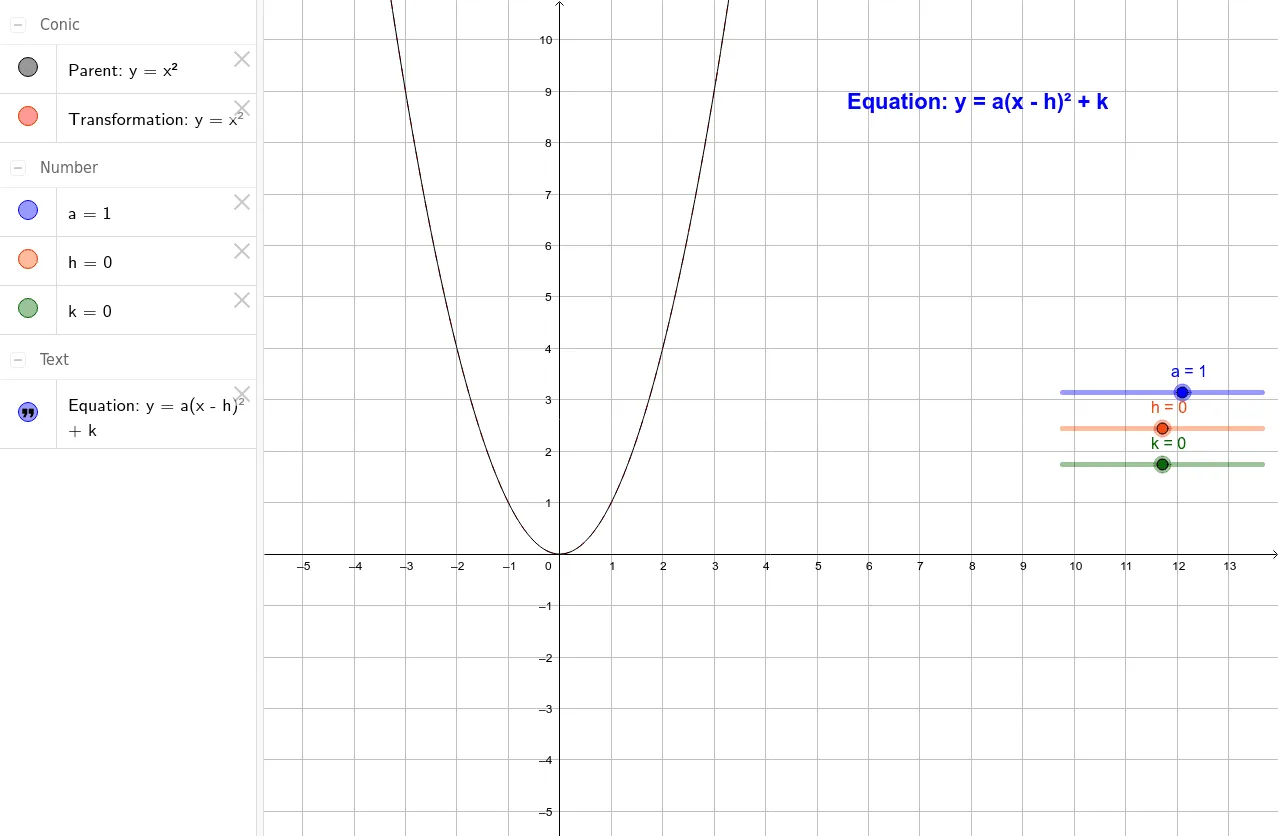
①This example uses dynamic sliders to visually demonstrate how the parameters a, h, and k in the quadratic parent function y = a(x-h)² + k affect the parabola's position, orientation, and vertical stretch, showing the combined influence on the graph's shape and location. ②Core mathematical concepts include the standard form of quadratic functions, vertex coordinates, axis of symmetry, direction of opening, and transformations such as horizontal/vertical translation and vertical scaling, fundamental to function transformation and coordinate geometry. ③Construction highlights: GeoGebra sliders (objects a, h, k) control each parameter; the Transformation object applies the mapping from the parent function to the new function; the Parent object marks the original parent parabola; text1 dynamically displays the current function expression, enabling real-time observation of how parameter changes correspond to graph changes. ④Suitable for middle-to-high school students learning properties of quadratic functions, as well as for teacher-led demonstrations or student self-exploration to grasp the effect of parameters on function graphs.
GeoGebra Commands & Parameters
Numeric a(1)Numeric h(0)Numeric k(0)y = (a * (x - h)^(2)) + kConic Parent
AI Drawing Prompt Reference
Draw a coordinate plane with a parabola and its transformations. The parabola follows the vertex form, where one parameter controls the opening direction and width, and two other parameters shift the vertex horizontally and vertically. Include a reference parent parabola and a transformed parabola, with the current equation displayed. Use dynamic sliders to adjust parameters, showing how the parabola moves, stretches, and changes orientation.
The prompt above was compiled from the original drawing commands and is for reference only.