
Parabola Locus: Construction with Tangents
Loading the math board and drawing, please wait…
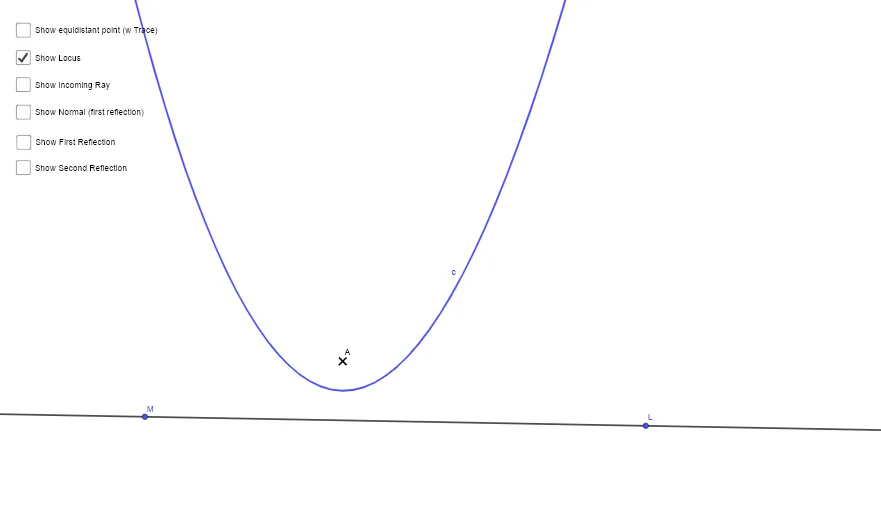
This example demonstrates how to build and verify the locus behavior of a parabola using a coordinated set of lines, rays, perpendicular constructs, and intersection points, while also highlighting tangent relationships. The key math ideas include the definition of a parabola via locus (focal–directrix/constant-distance reasoning), locus construction, tangent geometry, and measuring angular relations at relevant points. Construction highlights: it uses Line, Point, and Segment to create the foundational geometric elements; Parabola to define the parabola itself; OrthogonalLine to enforce perpendicular constraints; Intersect to determine crucial intersection points; Ray and Angle to set and evaluate directed relations; and Tangent to construct the tangent line at the appropriate point on the parabola. The scene is organized around multiple named objects (including the parabola f), auxiliary points, and angle/annotation elements (e.g., α). Suitable for advanced high-school geometry and early university analytic/constructive geometry lessons, as well as student explorations focusing on parabola properties and dynamic geometric verification.
GeoGebra Commands & Parameters
Line(L, M) → fParabola(A, f) → cPoint(c) → BSegment(A, B) → gOrthogonalLine(B, f) → hIntersect(f, h) → CSegment(C, B) → iOrthogonalLine(D, f) → jIntersect(c, j, 1) → ERay(E, D) → kLine(E, A) → lIntersect(c, l, 2) → FSegment(E, F) → mOrthogonalLine(F, f) → nPoint(n) → GRay(F, G) → pPoint(m) → HAngle(L, C, B) → αIntersect(c, k) → K,Tangent(K, c) → r,OrthogonalLine(K, r) → sIntersect(c, p) → N, OTangent(N, c) → t,OrthogonalLine(N, t) → aPoint(q) → PRay(N, P) → b
AI Drawing Prompt Reference
Draw a reference line and use it together with a designated point A to define a parabola as the locus. Construct a point B on the parabola from an intersection between the parabola and a perpendicular line to the reference line through B’s construction. Connect A and B with a segment, then build the perpendicular through B to the reference line and intersect it with the reference line to obtain C. Mark the angle α formed by the reference line and the segments/rays through C and B. Next, place another point E by intersecting the parabola with a second perpendicular to the reference line through a constructed point. From E, draw a ray toward a direction set by another constructed point D, and draw the line through E and A to meet the parabola again at F. Drop a perpendicular from F to the reference line to define a point G, and draw a ray from F through G. Finally, at key intersection points with the constructed rays/perpendiculars, draw tangents to the parabola and use corresponding perpendicular feet to highlight the tangent–orthogonality relationships, keeping the marked angle α and tangent lines visible.
The prompt above was compiled from the original drawing commands and is for reference only.