
Paper Folding Fractions
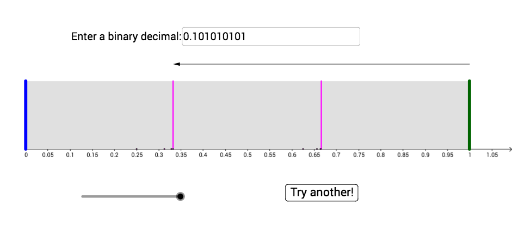
Loading the math board and drawing, please wait…
This example demonstrates the concept of fractions through paper folding. It involves mathematical concepts such as fractions, inequalities, and rotation. Using GeoGebra commands like Take, Reverse, Element, etc., a series of geometric shapes can be constructed. Suitable for students at the junior high school level and above to learn about fractions and geometric construction.
GeoGebra Commands & Parameters
Take(Text[num], 3, Length[Text[num]]) → text1Reverse(list1) → list2Element(list2, A2) → B2Polygon((0, 0), (1, 0), (1, 0.2), (0, 0.2)) → poly1, f, g, h, iTextfield(num) → InputBox1Length(Text[num]) → aElement(list2, A1) → B1Element(list2, A3) → B3Element(list2, A4) → B4Element(list2, A5) → B5Element(list2, A6) → B6Element(list2, A7) → B7Element(list2, A8) → B8Element(list2, A9) → B9Element(list2, A10) → B10Element(list2, A11) → B11Element(list2, A12) → B12Element(list2, A13) → B13Element(list2, A14) → B14If(Defined[B2], If[B2 ≟ 1, Dilate[C1, dfactor, (1, 0)], Dilate[C1, dfactor, (0, 0)]], (NaN, NaN)) → C2Element(list2, A15) → B15If(Defined[B3], If[B3 ≟ 1, Dilate[C2, dfactor, (1, 0)], Dilate[C2, dfactor, (0, 0)]], (NaN, NaN)) → C3If(Defined[B4], If[B4 ≟ 1, Dilate[C3, dfactor, (1, 0)], Dilate[C3, dfactor, (0, 0)]], (NaN, NaN)) → C4If(Defined[B5], If[B5 ≟ 1, Dilate[C4, dfactor, (1, 0)], Dilate[C4, dfactor, (0, 0)]], (NaN, NaN)) → C5If(Defined[B6], If[B6 ≟ 1, Dilate[C5, dfactor, (1, 0)], Dilate[C5, dfactor, (0, 0)]], (NaN, NaN)) → C6If(Defined[B7], If[B7 ≟ 1, Dilate[C6, dfactor, (1, 0)], Dilate[C6, dfactor, (0, 0)]], (NaN, NaN)) → C7If(Defined[B8], If[B8 ≟ 1, Dilate[C7, dfactor, (1, 0)], Dilate[C7, dfactor, (0, 0)]], (NaN, NaN)) → C8If(Defined[B9], If[B9 ≟ 1, Dilate[C8, dfactor, (1, 0)], Dilate[C8, dfactor, (0, 0)]], (NaN, NaN)) → C9If(Defined[B10], If[B10 ≟ 1, Dilate[C9, dfactor, (1, 0)], Dilate[C9, dfactor, (0, 0)]], (NaN, NaN)) → C10If(Defined[B11], If[B11 ≟ 1, Dilate[C10, dfactor, (1, 0)], Dilate[C10, dfactor, (0, 0)]], (NaN, NaN)) → C11If(Defined[B12], If[B12 ≟ 1, Dilate[C11, dfactor, (1, 0)], Dilate[C11, dfactor, (0, 0)]], (NaN, NaN)) → C12If(Defined[B13], If[B13 ≟ 1, Dilate[C12, dfactor, (1, 0)], Dilate[C12, dfactor, (0, 0)]], (NaN, NaN)) → C13If(Defined[B14], If[B14 ≟ 1, Dilate[C13, dfactor, (1, 0)], Dilate[C13, dfactor, (0, 0)]], (NaN, NaN)) → C14If(Defined[B15], If[B15 ≟ 1, Dilate[C14, dfactor, (1, 0)], Dilate[C14, dfactor, (0, 0)]], (NaN, NaN)) → C15Segment(C1, C1 + (0, 0.2)) → D1Segment(C2, C2 + (0, 0.2)) → D2Segment(C3, C3 + (0, 0.2)) → D3Segment(C4, C4 + (0, 0.2)) → D4Segment(C5, C5 + (0, 0.2)) → D5Segment(C6, C6 + (0, 0.2)) → D6Segment(C7, C7 + (0, 0.2)) → D7Segment(C8, C8 + (0, 0.2)) → D8Segment(C9, C9 + (0, 0.2)) → D9Segment(C10, C10 + (0, 0.2)) → D10Segment(C11, C11 + (0, 0.2)) → D11Segment(C12, C12 + (0, 0.2)) → D12Segment(C13, C13 + (0, 0.2)) → D13Segment(C14, C14 + (0, 0.2)) → D14Segment(C15, C15 + (0, 0.2)) → D15RemoveUndefined(list3) → list4RemoveUndefined(list5) → list6Sequence(FractionText[x(Element[list6, t])], t, 1, Length[list6]) → list7Segment((0, 0), (0, 0.2)) → jSegment((1, 0), (1, 0.2)) → kVector((1, 0.25), (0, 0.25)) → E1If(B2 ≟ 1, Vector[B, C1 + (0, 0.25)], Vector[A, C1 + (0, 0.25)]) → E2If(B4 ≟ 1, Vector[B, C3 + (0, 0.25)], Vector[A, C3 + (0, 0.25)]) → E4If(B5 ≟ 1, Vector[B, C4 + (0, 0.25)], Vector[A, C4 + (0, 0.25)]) → E5If(B6 ≟ 1, Vector[B, C5 + (0, 0.25)], Vector[A, C5 + (0, 0.25)]) → E6If(B3 ≟ 1, Vector[B, C2 + (0, 0.25)], Vector[A, C2 + (0, 0.25)]) → E3If(B7 ≟ 1, Vector[B, C6 + (0, 0.25)], Vector[A, C6 + (0, 0.25)]) → E7If(B8 ≟ 1, Vector[B, C7 + (0, 0.25)], Vector[A, C7 + (0, 0.25)]) → E8If(B9 ≟ 1, Vector[B, C8 + (0, 0.25)], Vector[A, C8 + (0, 0.25)]) → E9If(B10 ≟ 1, Vector[B, C9 + (0, 0.25)], Vector[A, C9 + (0, 0.25)]) → E10If(B11 ≟ 1, Vector[B, C10 + (0, 0.25)], Vector[A, C10 + (0, 0.25)]) → E11If(B12 ≟ 1, Vector[B, C11 + (0, 0.25)], Vector[A, C11 + (0, 0.25)]) → E12If(B13 ≟ 1, Vector[B, C12 + (0, 0.25)], Vector[A, C12 + (0, 0.25)]) → E13If(B14 ≟ 1, Vector[B, C13 + (0, 0.25)], Vector[A, C13 + (0, 0.25)]) → E14If(B15 ≟ 1, Vector[B, C14 + (0, 0.25)], Vector[A, C14 + (0, 0.25)]) → E15