
Overview of Geometric Transformations (Axes + Coordinates)
Loading the math board and drawing, please wait…
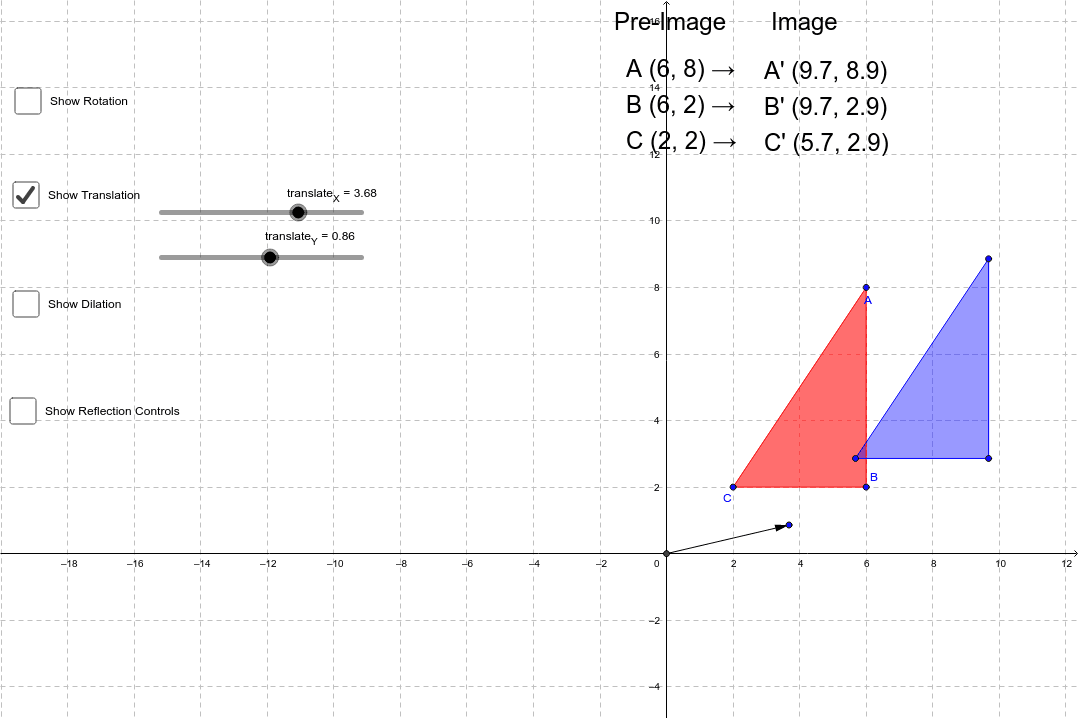
This example demonstrates the fundamental concepts of geometric transformations, including translation, rotation, dilation, and reflection, along with their corresponding coordinate representations. It involves core mathematical concepts such as coordinate geometry, vectors, and trigonometry. The construction highlights the use of commands like Polygon, Intersect, Circle, Rotate, Vector, Translate, Dilate, Segment, Mirror, CircleArc, and objects like translate_X, translate_Y, A, B, C, etc., to illustrate the transformation processes. Suitable for high school and above students to understand and master the principles and applications of geometric transformations.
GeoGebra Commands & Parameters
Polygon(A, B, C) → poly1, c, a_1, bIntersect(xAxis, yAxis) → DCircle(D, C) → eRotate(A, a°, D) → A'Rotate(B, a°, D) → B'Rotate(C, a°, D) → C'Polygon(A', B', C') → poly1', c', a', b'Vector(D, E) → uTranslate(A, u) → A'_1Translate(B, u) → B'_1Translate(C, u) → C'_1Polygon(A'_1, B'_1, C'_1) → poly1'_1, c'_1, a'_1, b'_1Dilate(A, scale, D) → A'_5Dilate(B, scale, D) → B'_5Dilate(C, scale, D) → C'_5Polygon(A'_5, B'_5, C'_5) → poly1'_5, c'_5, a'_5, b'_5Segment(F, G) → Mirror1Mirror(A, Mirror1) → A'_2Mirror(B, Mirror1) → B'_2Mirror(C, Mirror1) → C'_2Polygon(A'_2, B'_2, C'_2) → poly1'_2, c'_2, a'_2, b'_2Segment(H, I) → Mirror2Mirror(A'_2, Mirror2) → JMirror(B'_2, Mirror2) → KMirror(C'_2, Mirror2) → LPolygon(J, K, L) → poly2, l, j, kCircleArc(D, B, B') → fCircleArc(D, A, A') → gCircleArc(D, C, C') → p
AI Drawing Prompt Reference
Draw a coordinate system with x and y axes, intersecting at a point. Draw a circle centered at the intersection point, and three circles centered at the vertices of a triangle. Rotate the triangle's vertices around the intersection point by a certain angle to get new vertices, connect them to form a new triangle. Translate the new triangle along the x-axis using a vector, then dilate it from the intersection point. Reflect the dilated triangle across lines parallel to the x and y axes to get two new triangles. Connect the original and rotated vertices with arcs.
The prompt above was compiled from the original drawing commands and is for reference only.