
Orthocenter Animation
Loading the math board and drawing, please wait…
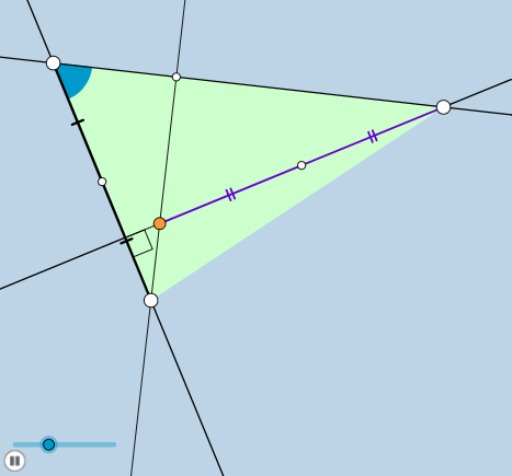
This example demonstrates the orthocenter animation of a triangle. The orthocenter is the point where the three altitudes of a triangle intersect. Using GeoGebra commands such as Rotate, Angle, Segment, Ray, Point, Circle, Intersect, etc., the formation process of the orthocenter can be dynamically shown. Suitable for students at junior high school level and above to learn triangle geometry.
GeoGebra Commands & Parameters
Rotate(A, (a * π / 180), B) → A'Angle(A, B, A') → αSegment(B, A) → fRay(B, A') → gPoint(g) → CSegment(B, C) → hCircle(B, b) → cIntersect(c, f, 1) → DIntersect(c, h, 1) → ECircleSector(B, D, E) → dSegment(C, A) → iLine(C, A) → jLine(A, B) → kOrthogonalLine(C, k) → mIntersect(m, k) → HCircle(C, 2) → eCircle(H, 2) → pIntersect(e, j, 1) → JRay(C, J) → nLine(C, H) → rPolygon(B, A, C) → poly1, c_1, b_1, a_1Angle(C, A, B) → βMidpoint(f) → IAngle(A, H, C) → δLine(C, B) → lOrthogonalLine(A, l) → qIntersect(q, l) → FAngle(B, F, A) → γIntersect(q, r) → GSegment(C, H) → sLine(C, H) → tCircle(C, 2) → d_1Circle(H, 2) → e_1Intersect(d_1, t, 1) → LIntersect(e_1, t) → M, NRay(C, L) → f_1Ray(H, N) → g_1Segment(C, H) → h_1Midpoint(C, G) → OCircle(B, 1) → k_1Circle(A, 1) → p_1Intersect(k_1, k, 2) → PIntersect(p_1, k, 1) → QRay(B, P) → i_1Ray(A, Q) → j_1Dilate(B, If[0 < o ≤ 1, 1 - o, 0], I) → B'Segment(B, B') → l_1Rotate(B, If[1 < o ≤ 2, ((-(o - 1)) * π), (-π)], I) → B'_1Rotate(B', If[1 < o ≤ 2, ((-(o - 1)) * π), (-π)], I) → B''Segment(B'_1, B'') → m_1Intersect(k_1, l, 2) → KCircle(C, 2) → q_1Intersect(q_1, l, 1) → RSegment(B, C) → n_1Ray(C, R) → r_1Ray(B, K) → s_1Dilate(A, If[2 < o ≤ 3, 3 - o, 0], F) → A'_1Segment(A, A'_1) → t_1Dilate(C, If[3 < o ≤ 4, 4 - o, 0], O) → C'Segment(C, C') → f_2Dilate(O, If[4 < o ≤ 5, 5 - o, 0], G) → O'Segment(O, O') → g_2Dilate(G, If[5 < o ≤ 6, 6 - o, 0], H) → G'Segment(G, G') → h_2Rotate(C, If[6 < o ≤ 7, ((-(o - 6)) * π), (-π)], O) → C'_1Rotate(C', If[6 < o ≤ 7, ((-(o - 6)) * π), (-π)], O) → C''Segment(C'_1, C'') → i_2Angle(I, F, O) → εDilate(I, If[8 < o ≤ 9, 9 - o, 0], F) → I'Dilate(O, If[8 < o ≤ 9, 9 - o, 0], F) → O'_1Segment(I, I') → j_2Segment(O, O'_1) → k_2Line(A, F) → l_2Line(C, B) → m_2
AI Drawing Prompt Reference
Draw a triangle ABC and dynamically show the formation process of its orthocenter H. First, use rotation and angle calculation to determine the position of point C, then draw the three altitudes of the triangle and find their intersection point, which is the orthocenter H. Finally, rotate and move point B to dynamically show the change in the position of the orthocenter H.
The prompt above was compiled from the original drawing commands and is for reference only.