
Opposite Sides of Rectangles Are Parallel
Loading the math board and drawing, please wait…
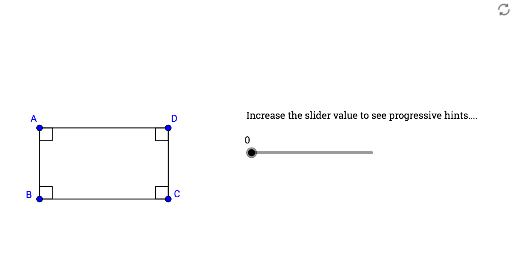
This example demonstrates the geometric property that opposite sides of rectangles are parallel. It involves core mathematical concepts such as parallel lines, the definition of rectangles, and linear equations in analytical geometry. The construction uses GeoGebra commands/objects like Segment, OrthogonalLine, Point, Angle, Intersect, and Line. It is suitable for high school students learning and understanding the basic properties of rectangles and the relationship between lines and shapes in analytical geometry.
GeoGebra Commands & Parameters
Segment(A, B) → fOrthogonalLine(B, f) → gPoint(g) → CAngle(C, B, A) → ζSegment(B, C) → hOrthogonalLine(C, h) → iOrthogonalLine(B, h) → jOrthogonalLine(A, f) → kIntersect(i, k) → DSegment(C, D) → lSegment(D, A) → mAngle(B, A, D) → αAngle(A, D, C) → βAngle(D, C, B) → γLine(A, D) → pLine(B, C) → qLine(A, B) → r
AI Drawing Prompt Reference
Draw a rectangle with parallel opposite sides. Start by drawing segment AB, then draw a line g perpendicular to AB through point B, and determine point C on line g. Next, draw angle ζ at point C, draw segment BC, then draw a line i perpendicular to BC through point C, a line j perpendicular to BC through point B, and a line k perpendicular to AB through point A. The intersection of line i and line k is point D, draw segment CD and segment DA, and finally draw segment AB and segment CD, ensuring they are parallel.
The prompt above was compiled from the original drawing commands and is for reference only.