
Opposite Sides of Parallelograms Are Congruent
Loading the math board and drawing, please wait…
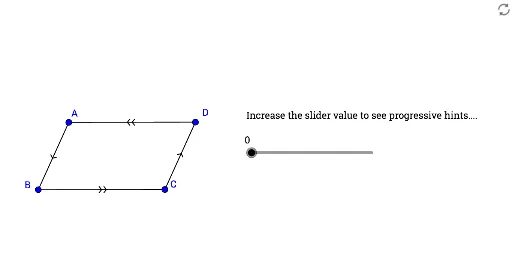
This GeoGebra example dynamically demonstrates the theorem that opposite sides of a parallelogram are congruent. It constructs a parallelogram and its rotated copy using commands such as Polygon, Midpoint, Rotate, Line, Angle, and Segment. The construction includes points A, B, C, the parallelogram poly1, its rotated version poly1', and auxiliary lines and angles, with text objects displaying side lengths. The core mathematical concept is the property of parallelograms: opposite sides are equal in length. The example is ideal for middle school geometry lessons, helping students visualize and verify this fundamental property through interactive manipulation. It also introduces rotation transformations and measurement, making it suitable for exploring geometric congruence and symmetry.
GeoGebra Commands & Parameters
Polygon(A, B, C) → poly1, c, a, bMidpoint(A, C) → MRotate(A, 180°, M) → A'Rotate(B, 180°, M) → B'Rotate(C, 180°, M) → C'Polygon(A', B', C') → poly1', c', a', b'Line(A, B') → fLine(B, C) → gLine(A, C) → hAngle(A, C, B) → αAngle(C, A, B') → βLine(A, B) → iLine(C, B') → jLine(A, C) → kAngle(B, A, C) → γAngle(B', C, A) → δSegment(A, C) → l