
Opposite Angles Supplementary in Cyclic Quadrilateral
Loading the math board and drawing, please wait…
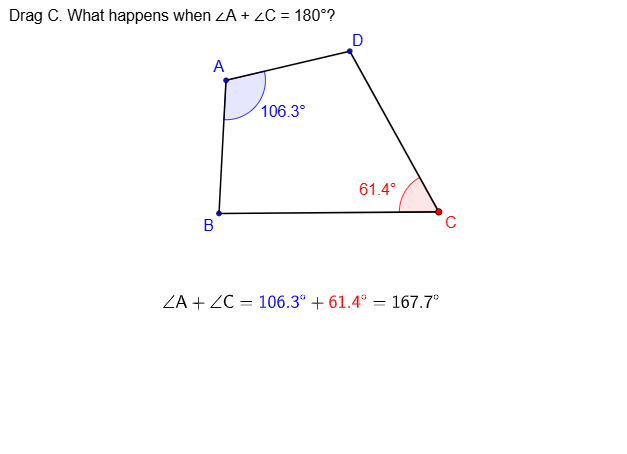
This GeoGebra example dynamically demonstrates the key property of a cyclic quadrilateral: opposite angles are supplementary (their sum is 180°). The core mathematical concepts involve the inscribed angle theorem, the sum of interior angles in a quadrilateral, and dynamic angle measurement. Construction highlights: a circle is created using the Circle command, intersection points are obtained via Intersect, DynamicCoordinates allows points to move along the circle, Angle measures angles α and β, Segment connects the quadrilateral sides, and conditional commands like If, near, and located drive dynamic text updates. Suitable for middle and high school geometry classes, this interactive tool lets students drag vertices to observe that opposite angles always sum to 180°, reinforcing the theorem through exploration.
GeoGebra Commands & Parameters
Circle(A, D, B) → cIntersect(c, Line[D, D_1], 2) → D'If(Distance[D_1, D'] < 0.15, true, false) → nearDynamicCoordinates(D_1, If[near, x(D'), x(D_1)], If[near, y(D'), y(D_1)]) → CAngle(D, A, B) → αSegment(D, A) → aSegment(A, B) → bSegment(D, C) → dSegment(C, B) → eAngle(D, C, B) → βIf(C ≟ D' ∧ β ≟ 180° - α, true, false) → located