
Opposite Angles of a Cyclic Quadrilateral by James Monaghan
Loading the math board and drawing, please wait…
In collections
Circle Geometry
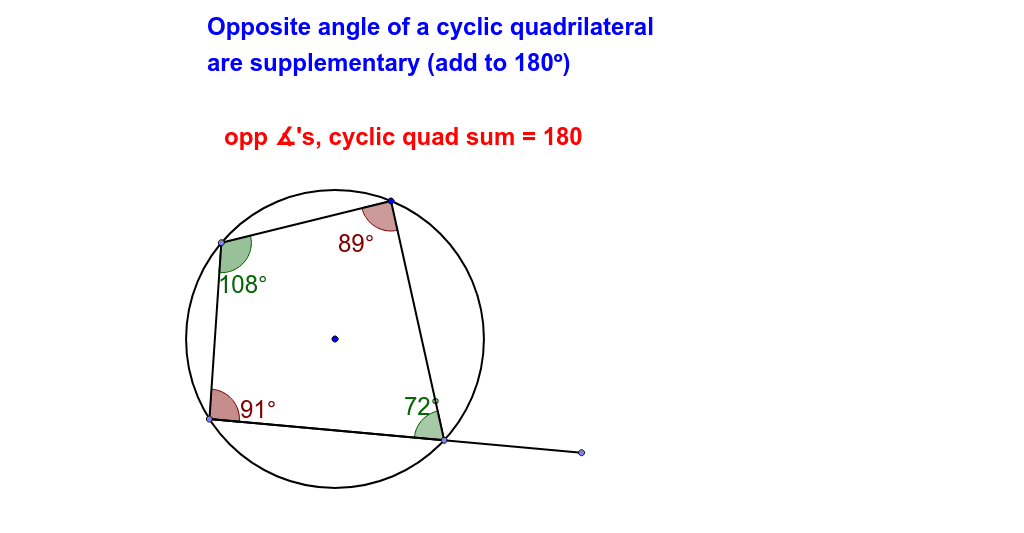
This example illustrates the properties of a cyclic quadrilateral, particularly the relationship between its opposite angles. It involves basic concepts of circles and geometry. Using GeoGebra commands such as Polygon, Angle, and Circle, it dynamically demonstrates the relationship between the opposite angles and the circle. Suitable for middle and high school students studying geometry and circle properties.
GeoGebra Commands & Parameters
Polygon(E_1, H_1, G_1, F_1) → poly1, e_2, h_2, g_2, f_2Angle(G_1, F_1, E_1) → λAngle(E_1, H_1, G_1) → ξAngle(F_1, E_1, H_1) → οAngle(H_1, G_1, F_1) → ρCircle(D_1, E_3) → e_1Point(e_1) → F_3Point(e_1) → G_3Segment(F_3, G_3) → f_1Point(e_1) → H_3Segment(G_3, H_3) → g_1Segment(H_3, E_3) → h_1Segment(E_3, F_3) → i_1Angle(F_3, G_3, H_3) → γ_2Angle(F_3, E_3, H_3) → δ_2Angle(G_3, F_3, E_3) → ε_2Angle(G_3, H_3, E_3) → ζ_2Ray(G_3, H_3) → j_3Point(j_3) → I_4Point(j_3) → I_1Segment(G_3, I_1) → j_1
AI Drawing Prompt Reference
Draw a cyclic quadrilateral by connecting four points and showing the diagonals. Then measure and display the degree of each interior angle, especially the angles formed by the diagonals. Finally, draw the extensions of the diagonals and mark the new intersection points.
The prompt above was compiled from the original drawing commands and is for reference only.