
Octahedron Net Animation
Loading the math board and drawing, please wait…
In collections
Area, Surface Area, Volume--Nets
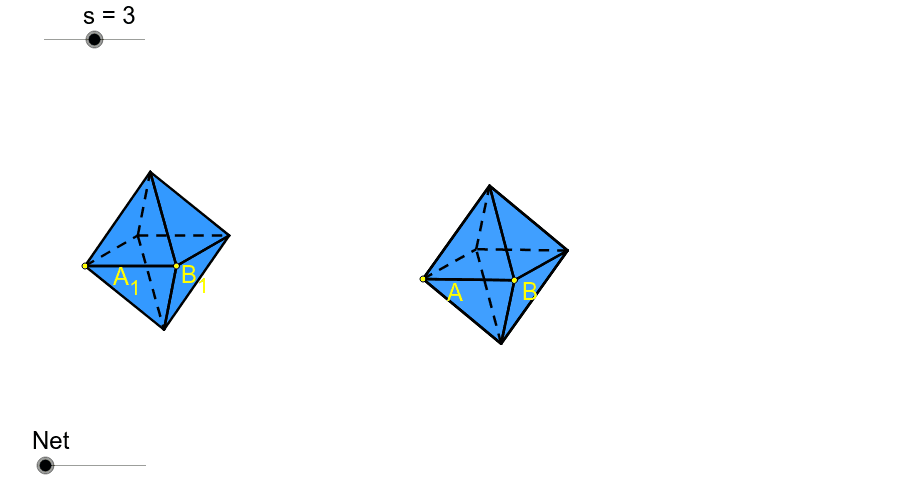
This GeoGebra example demonstrates the net of an octahedron and animates its construction process. Key mathematical concepts include solid geometry and geometric construction. It uses commands such as point, line segment, circle, rotation, and mirror. Suitable for middle school and above students learning solid geometry and geometric construction.
GeoGebra Commands & Parameters
Point(Circle[A, s]) → BSegment(A, B) → aLine(A, B) → bCircle(B, 3.0 * s / 4.5) → cIntersect(c, b, 2.0) → CRotate(C, 30.0*°, B) → C'Line(C', b) → dSegment(B, C') → eLine(A, e) → fIntersect(d, f) → DSegment(A, C') → gSegment(D, B) → hIntersect(g, h) → EOrthogonalLine(E, a) → iRotate(i, 5.0*°, E) → i'Circle(E, s * sqrt(3.0) / 2.0) → kIntersect(k, i', 1.0) → FIntersect(k, i', 2.0) → GPolygon(D, C', 3.0) → poly1, j, d_1, c', HPolygon(D, H, 3.0) → poly2, l, d_2, h_1, IPolygon(I, H, 3.0) → poly3, m, i_1, h_2, JPolygon(H, C', 3.0) → poly4, n, h_3, c'_1, KPolygon(C', D, 3.0) → poly5, p, c'_2, d_3, LPolygon(C', L, 3.0) → poly6, q, c'_3, l_1, MPolygon(L, D, 3.0) → poly7, r, l_2, d_4, NPolygon(M, L, 3.0) → poly8, t, m_1, l_3, OPolygon(G, A, D) → poly9, d_5, g_1, a_1Mirror(D, d_5) → D'Vector(B, D') → uVector(A, I) → vVector(D', J) → wCircle(J, D', B) → c_1Translate(B, Vector[u * o]) → B'_1Center(c_1) → PRay(P, B'_1) → b_1Intersect(c_1, b_1, 1.0) → QTranslate(D', Vector[w * (o - 1.0)]) → D''Ray(P, D'') → e_1Intersect(c_1, e_1, 1.0) → RIf(o < 1.0, Q, If[o < 2.0, R, J]) → SSegment(I, A) → f_1LineBisector(f_1) → j_1Intersect(f, j_1) → TCircleArc(T, I, A) → k_1Translate(A, Vector[v * (o - 1.0)]) → A'_1Ray(T, A'_1) → n_1Intersect(k_1, n_1, 1.0) → UIf(o < 1.0, A, If[o < 2.0, U, I]) → VSegment(B, K) → p_1LineBisector(p_1) → q_1Intersect(q_1, c') → ZVector(G, H) → zVector(B, K) → u_1Translate(G, Vector[z * (o - 1.0)]) → G'LineBisector(G, H) → r_1Intersect(b, r_1) → WCircleArc(W, H, G) → s_1Ray(W, G') → t_1Intersect(s_1, t_1) → A_1,If(o < 1.0, G, If[o < 2.0, A_1, H]) → B_1Polygon(B_1, D, C') → poly10, c'_4, b_2, d_6Polygon(V, B_1, S) → poly11, s_2, v_1, b_3Polygon(V, D, B_1) → poly12, b_4, v_2, d_7LineBisector(K, B) → a_2LineBisector(A, B) → c_2OrthogonalLine(H, b) → e_2Intersect(b, c_2) → C_1Intersect(e_2, b) → D_1Vector(C_1, D_1) → w_1Translate(c_2, Vector[w_1 * (o - 1.0)]) → f_2Mirror(V, f_2) → V'If(o < 1.0, B, If[o < 2.0, V', K]) → E_1Polygon(B_1, E_1, C') → poly13, c'_5, b_5, e_3Polygon(B_1, D, C') → poly14, c'_6, b_6, d_8Midpoint(A, B) → F_1Vector(B, M) → z_1Vector(F, L) → u_2Polygon(C', B, F) → poly15, f_3, c'_7, b_7Mirror(C', B) → C''Vector(A, C'') → w_2Vector(A, N) → g_2Circle(C'', s / 5.0) → k_2Line(C', B) → i_2Intersect(k_2, i_2, 2.0) → G_1CircumcircleArc(A, G_1, O) → p_2Center(p_2) → H_1Translate(A, Vector[w_2 * (o - 2.0)]) → A'Ray(H_1, A') → j_2Intersect(p_2, j_2, 1.0) → I_1Vector(G_1, O) → z_2Translate(G_1, Vector[z_2 * (o - 3.0)]) → J_1Ray(H_1, J_1) → m_2Intersect(p_2, m_2, 1.0) → K_1If(o < 2.0, A, If[o < 3.0, I_1, If[o < 4.0, K_1, O]]) → L_1LineBisector(B, M) → n_2Translate(B, Vector[z_1 * (o - 3.0)]) → B'Segment(A, H_1) → q_2Segment(B, M) → r_2Intersect(n_2, r_2) → M_1Intersect(n_2, q_2) → N_1CircleArc(N_1, B, M) → t_2Ray(N_1, B') → a_3Intersect(t_2, a_3, 1.0) → O_1If(o < 3.0, B, If[o < 4.0, O_1, M]) → P_1LineBisector(F, L) → c_3Intersect(l_2, c_3) → Q_1CircleArc(Q_1, F, L) → g_3Translate(F, Vector[u_2 * (o - 3.0)]) → F'Ray(Q_1, F') → i_3Intersect(g_3, i_3, 1.0) → R_1If(o < 3.0, F, If[o < 4.0, R_1, L]) → S_1Polygon(S_1, P_1, L_1) → poly16, l_4, s_3, p_3Polygon(S_1, C', P_1) → poly17, p_4, s_4, c'_8Polygon(S_1, C', D) → poly18, d_9, s_5, c'_9Midpoint(A, B) → T_1OrthogonalLine(T_1, b) → j_3Intersect(b, e_2) → U_1Vector(T_1, U_1) → u_3Translate(j_3, Vector[u_3 * (o - 3.0)]) → k_3Mirror(P_1, k_3) → V_1If(o < 3.0, A, If[o < 4.0, V_1, N]) → W_1Polygon(W_1, S_1, D) → poly19, d_{10}, w_3, s_6Intersect(b_6, s_5) → Z_1Intersect(c'_5, s_5) → A_2Intersect(b_4, s_6) → B_2Intersect(v_1, s_6) → C_2Segment(C_2, A) → m_3Segment(C_2, D) → n_3Segment(V, D) → q_3Segment(C', A_2) → r_3Segment(D, A_2) → t_3Intersect(v_1, t_3) → D_2Segment(D_2, A_2) → a_4Segment(D_2, D) → c_4Intersect(s_3, c'_9) → E_2Segment(E_2, S_1) → e_4Intersect(v_1, c'_9) → F_2Segment(F_2, E_2) → f_4Segment(F_2, D) → g_4Segment(E_2, D) → h_4Intersect(b_3, c'_9) → G_2Segment(G_2, D) → i_4Segment(G_2, E_2) → j_4Point(Circle[H_2, s]) → I_2Segment(H_2, I_2) → k_4Line(H_2, I_2) → m_4Circle(I_2, 3.0 * s / 4.5) → q_4Intersect(q_4, m_4, 2.0) → J_2Rotate(J_2, 30.0*°, I_2) → K_2Line(K_2, m_4) → n_4Segment(I_2, K_2) → r_4Line(H_2, r_4) → t_4Intersect(n_4, t_4) → L_2Segment(H_2, K_2) → a_5Segment(I_2, L_2) → c_5Intersect(a_5, c_5) → M_2Circle(M_2, s * sqrt(3.0) / 2.0) → e_5OrthogonalLine(M_2, m_4) → f_5Rotate(f_5, 5.0*°, M_2) → g_5Intersect(e_5, g_5, 2.0) → N_2Intersect(e_5, g_5, 1.0) → O_2Polygon(H_2, I_2, N_2) → poly20, n_5, h_5, i_5Polygon(N_2, K_2, I_2) → poly21, i_6, n_6, k_5Polygon(I_2, K_2, O_2) → poly22, o_2, i_7, k_6Polygon(O_2, H_2, I_2) → poly23, i_8, o_1, h_6Segment(H_2, L_2) → j_5Segment(L_2, N_2) → l_5Segment(L_2, K_2) → m_5Segment(L_2, O_2) → p_5
AI Drawing Prompt Reference
Draw the net of an octahedron and show its construction process step by step. Start by creating a circle with center A, select a point B on the circle, and draw a line segment AB. Then draw a line b parallel to AB. Next, draw a circle with center B and radius 3/4.5 times the circle's radius, intersecting line b at point C. Rotate C 30 degrees around B to get C', draw a line d parallel to BC', and draw a line f parallel to AB, intersecting d at point D. Draw a line g from A to D, and a line h from B to D, intersecting g and h at point E. Draw a perpendicular line i from E, rotate i to get i', and draw a circle k with center E and radius sqrt(3)/2 times the circle's radius, intersecting i' at points F and G. Connect these points to form the net of the octahedron.
The prompt above was compiled from the original drawing commands and is for reference only.