
Numbers in Different Bases
Loading the math board and drawing, please wait…
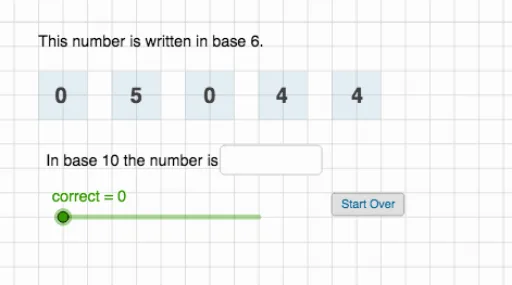
This example demonstrates how to represent a number in different bases using GeoGebra. It involves core mathematical concepts such as base conversion, numerical representation, and mathematical visualization. The construction utilizes commands like Random for generating random numbers, Polygon for drawing polygons, and Textfield for displaying text, along with objects like a, f0, f1, f2, f3, f4, ans, A, B, C, D, q1, and others. It is suitable for high school and above students to understand number base representation and enhance their grasp of numerical conversion and mathematical visualization.
GeoGebra Commands & Parameters
Random(0, a - 1) → f0Random(0, a - 1) → f1Random(0, a - 1) → f2Random(0, a - 1) → f3Random(0, a - 1) → f4Polygon(A, B, C, D) → q1, a_1, b, c, dPolygon(A_1, B_1, C_1, D_1) → q1_1, a_2, b_1, c_1, d_1Polygon(A_2, B_2, C_2, D_2) → q1_2, a_3, b_2, c_2, d_2Polygon(A_3, B_3, C_3, D_3) → q1_3, a_4, b_3, c_3, d_3Polygon(A_4, B_4, C_4, D_4) → q1_4, a_5, b_4, c_4, d_4Textfield(empty) → InputBox1
AI Drawing Prompt Reference
Draw a graphic showing a decimal number converted to different bases (binary, octal, decimal, hexadecimal). First, generate four random numbers between 0 and a-1, then use these numbers to draw four polygons, each representing a number in a different base. Finally, use a text field to display an input box for entering or showing the converted number.
The prompt above was compiled from the original drawing commands and is for reference only.