
Number Sense - Level 2: Comparing and Locating Rational Numbers
Loading the math board and drawing, please wait…
In collections
Rationale Zahlen & Arbeiten mit der Zahlengerade
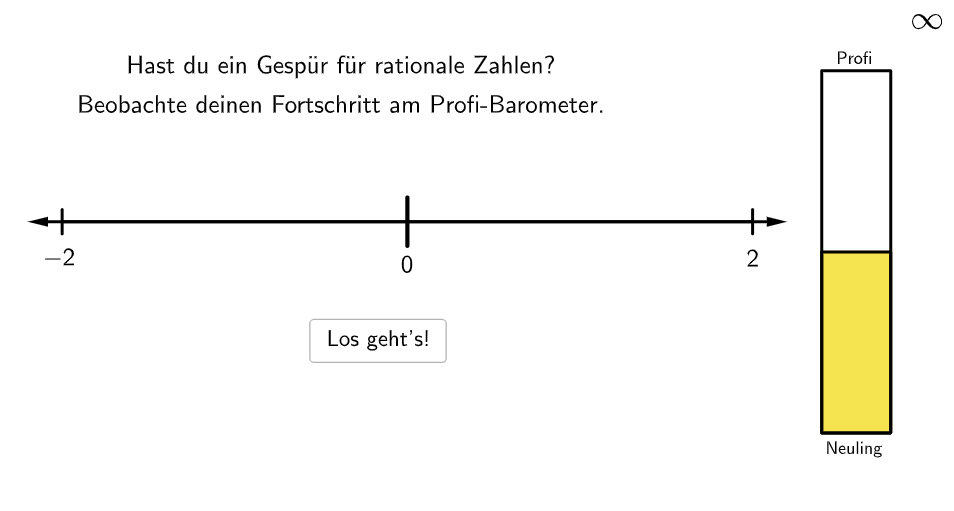
① This interactive GeoGebra example is a number-sense training tool for middle school students, generating random rational numbers (including integers, decimals, fractions, and signed numbers) and asking learners to compare them or place them on a number line. ② The core mathematical concepts are comparing and ordering rational numbers, and representing rational numbers on the number line, covering positive/negative values, decimals, and fractions. ③ Construction highlights: The applet uses GeoGebra commands such as RandomElement, Vector, Segment, Join, Remove, Unique, Element, Polygon, If, and Text to build a dynamic question system. Sliders (maxNums, minNums) control difficulty, while random number generators (randomNos, numbersGanze, numbers3Dezimal1Neg, etc.) produce varied rational number types. A button (button1) triggers new questions, and interactive elements (showrect, showsolution) provide feedback, with a counter (countCorrect) tracking performance. ④ It is designed for grades 7-8 to reinforce rational number concepts and develop number sense, suitable for classroom use or self-paced practice.
GeoGebra Commands & Parameters
RandomElement(minNums) → minNumRandomElement(maxNums) → maxNumVector(A + (0.5, 0), B) → uSegment((10, b), (10, (-b))) → gJoin({{100}, Shuffle[Sequence[Random[5, 95], i, 1, 100]]}) → randomNosRemove((((minNum * 10) + 1)…0) / 10, numbersGanze) → numbers3Dezimal1NegRemove((0…((maxNum * 10) - 1)) / 10, numbersGanze) → numbers4Dezimal1PosRemove((((minNum * 100) + 1)…0) / 100, Flatten[{numbersGanze, numbers3Dezimal1Neg}]) → numbers5Dezimal2NegRemove((0…((maxNum * 100) - 1)) / 100, Flatten[{numbersGanze, numbers4Dezimal1Pos}]) → numbers6Dezimal2PosUnique(Flatten[Zip[Sequence[Sequence[j - i / a, i, 1, a - 1], j, minNum + 1, 0], a, {2, 3, 4, 5, 6, 8, 10}]]) → numbers1BruecheNegUnique(Flatten[Zip[Sequence[Sequence[j + i / a, i, 1, a - 1], j, 0, maxNum - 1], a, {2, 3, 4, 5, 6, 8, 10}]]) → numbers2BruechePosJoin(Sequence[Shuffle[{1, 1, 1, 1, 2, 2, 3, 3, 4, 5, 5, 6}], i, 1, 10]) → numbersToTakeWSKElement(numbersToTakeWSK, Mod[count, Length[numbersToTakeWSK]] + 1) → actualNumberToTakeWSKElement(numbersAll, actualNumberToTakeWSK) → numbersRandomElement(numbers) → numPolygon((Max[0, If[numPos ≥ numZero > numPos - 0.5, numZero, numPos - 0.5]], -0.3), (Min[10, If[numPos < numZero ≤ numPos + 0.5, numZero, numPos + 0.5]], -0.3), (Min[10, If[numPos < numZero ≤ numPos + 0.5, numZero, numPos + 0.5]], 0.3), (Max[0, If[numPos ≥ numZero > numPos - 0.5, numZero, numPos - 0.5]], 0.3)) → q1, h, i, j, kSegment((0, 0), (0.1, 0)) → P0Segment((0.1, 0), (0.2, 0)) → P1Segment((0.2, 0), (0.3, 0)) → P2Segment((0.3, 0), (0.4, 0)) → P3Segment((0.4, 0), (0.5, 0)) → P4Segment((0.5, 0), (0.6, 0)) → P5Segment((0.6, 0), (0.7, 0)) → P6Segment((0.7, 0), (0.8, 0)) → P7Segment((0.8, 0), (0.9, 0)) → P8Segment((0.9, 0), (1, 0)) → P9Segment((1, 0), (1.1, 0)) → P10Segment((1.1, 0), (1.2, 0)) → P11Segment((1.2, 0), (1.3, 0)) → P12Segment((1.3, 0), (1.4, 0)) → P13Segment((1.4, 0), (1.5, 0)) → P14Segment((1.5, 0), (1.6, 0)) → P15Segment((1.6, 0), (1.7, 0)) → P16Segment((1.7, 0), (1.8, 0)) → P17Segment((1.8, 0), (1.9, 0)) → P18Segment((1.9, 0), (2, 0)) → P19Segment((2, 0), (2.1, 0)) → P20Segment((2.1, 0), (2.2, 0)) → P21Segment((2.2, 0), (2.3, 0)) → P22Segment((2.3, 0), (2.4, 0)) → P23Segment((2.4, 0), (2.5, 0)) → P24Segment((2.5, 0), (2.6, 0)) → P25Segment((2.6, 0), (2.7, 0)) → P26Segment((2.7, 0), (2.8, 0)) → P27Segment((2.8, 0), (2.9, 0)) → P28Segment((2.9, 0), (3, 0)) → P29Segment((3, 0), (3.1, 0)) → P30Segment((3.1, 0), (3.2, 0)) → P31Segment((3.2, 0), (3.3, 0)) → P32Segment((3.3, 0), (3.4, 0)) → P33Segment((3.4, 0), (3.5, 0)) → P34Segment((3.5, 0), (3.6, 0)) → P35Segment((3.6, 0), (3.7, 0)) → P36Segment((3.7, 0), (3.8, 0)) → P37Segment((3.8, 0), (3.9, 0)) → P38Segment((3.9, 0), (4, 0)) → P39Segment((4, 0), (4.1, 0)) → P40Segment((4.1, 0), (4.2, 0)) → P41Segment((4.2, 0), (4.3, 0)) → P42Segment((4.3, 0), (4.4, 0)) → P43Segment((4.4, 0), (4.5, 0)) → P44Segment((4.5, 0), (4.6, 0)) → P45Segment((4.6, 0), (4.7, 0)) → P46Segment((4.7, 0), (4.8, 0)) → P47Segment((4.9, 0), (5, 0)) → P49Segment((5, 0), (5.1, 0)) → P50Segment((5.1, 0), (5.2, 0)) → P51Segment((5.2, 0), (5.3, 0)) → P52Segment((5.3, 0), (5.4, 0)) → P53Segment((5.4, 0), (5.5, 0)) → P54Segment((5.5, 0), (5.6, 0)) → P55Segment((5.6, 0), (5.7, 0)) → P56Segment((5.7, 0), (5.8, 0)) → P57Segment((5.8, 0), (5.9, 0)) → P58Segment((5.9, 0), (6, 0)) → P59Segment((6, 0), (6.1, 0)) → P60Segment((6.1, 0), (6.2, 0)) → P61Segment((6.2, 0), (6.3, 0)) → P62Segment((6.3, 0), (6.4, 0)) → P63Segment((6.4, 0), (6.5, 0)) → P64Segment((6.5, 0), (6.6, 0)) → P65Segment((6.6, 0), (6.7, 0)) → P66Segment((6.7, 0), (6.8, 0)) → P67Segment((6.8, 0), (6.9, 0)) → P68Segment((6.9, 0), (7, 0)) → P69Segment((7, 0), (7.1, 0)) → P70Segment((7.1, 0), (7.2, 0)) → P71Segment((7.2, 0), (7.3, 0)) → P72Segment((7.3, 0), (7.4, 0)) → P73Segment((7.4, 0), (7.5, 0)) → P74Segment((7.5, 0), (7.6, 0)) → P75Segment((7.6, 0), (7.7, 0)) → P76Segment((7.7, 0), (7.8, 0)) → P77Segment((7.8, 0), (7.9, 0)) → P78Segment((7.9, 0), (8, 0)) → P79Segment((8, 0), (8.1, 0)) → P80Segment((8.1, 0), (8.2, 0)) → P81Segment((8.2, 0), (8.3, 0)) → P82Segment((8.3, 0), (8.4, 0)) → P83Segment((8.4, 0), (8.5, 0)) → P84Segment((8.5, 0), (8.6, 0)) → P85Segment((8.6, 0), (8.7, 0)) → P86Segment((8.7, 0), (8.8, 0)) → P87Segment((8.8, 0), (8.9, 0)) → P88Segment((8.9, 0), (9, 0)) → P89Segment((9, 0), (9.1, 0)) → P90Segment((9.1, 0), (9.2, 0)) → P91Segment((9.2, 0), (9.3, 0)) → P92Segment((9.3, 0), (9.4, 0)) → P93Segment((9.4, 0), (9.5, 0)) → P94Segment((9.5, 0), (9.6, 0)) → P95Segment((9.6, 0), (9.7, 0)) → P96Segment((9.7, 0), (9.8, 0)) → P97Segment((9.8, 0), (9.9, 0)) → P98Segment((9.9, 0), (10, 0)) → P99Segment((10, 0), (10.1, 0)) → P100Segment((4.8, 0), (4.9, 0)) → P48If(floor(barometer / 2) + 1 ≥ 10, 10, floor(barometer / 2) + 1) → colorIndexPolygon((-1, -7), (17, -7), (17, 4), (-1, 4)) → canvas, l, m, n, pVector(B - (0.5, 0), A) → u1Segment((0, b), (0, (-b))) → g1Segment((numZero, a), (numZero, (-a))) → fVector((numPos, -0.4), (numPos, 0)) → vElement(randomNos, Mod[count, Length[randomNos]] + 1) → randomNumUnusedText("\textsf{" + numText + "}", (numPos - 0.02, -1.0), true, true, 0, 0) → text6
AI Drawing Prompt Reference
This is a number line graphic for training rational number concepts. The number line will randomly generate rational number points representing integers, decimals, fractions, and signed numbers that learners need to compare or locate. The graphic includes a counter to track correct answers and interactive elements like prompts and feedback buttons to help students understand comparing and ordering rational numbers. The construction order is: first draw the number line, then generate random rational numbers based on the slider settings, mark these points, display comparison questions, and finally update the counter.
The prompt above was compiled from the original drawing commands and is for reference only.