
Number Line of Musical Notes: 2D Mapping of Chords and Scales
Loading the math board and drawing, please wait…
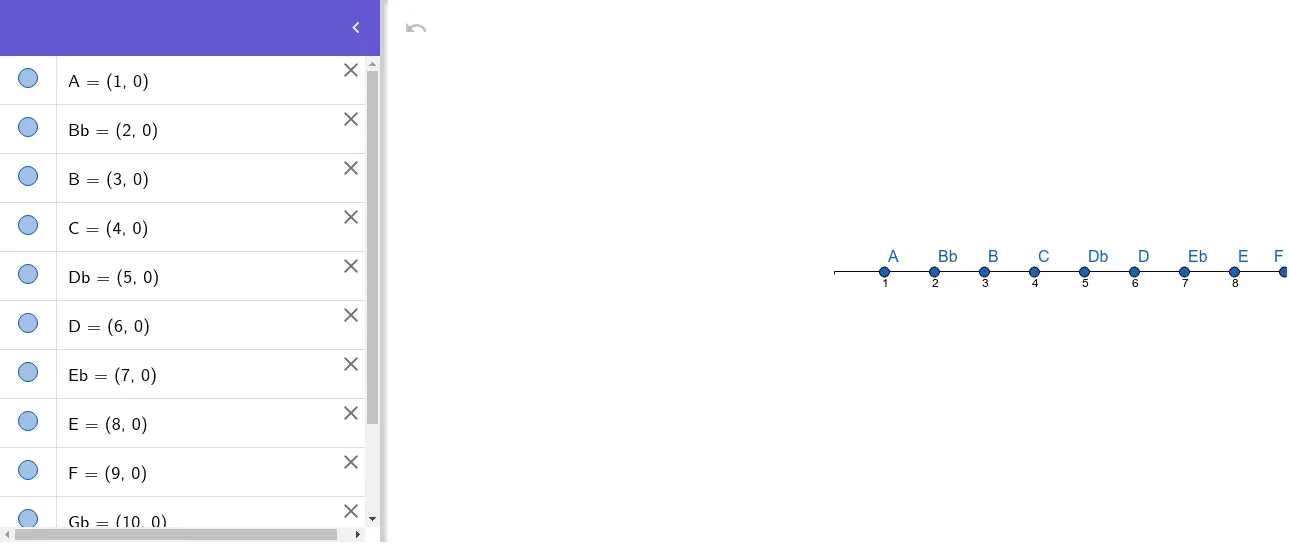
This GeoGebra example maps the twelve musical notes (A, Bb, B, C, Db, D, Eb, E, F, Gb, G, Ab) onto a number line, creating a linear arrangement of pitches, and further extends to a 2D coordinate mapping to visualize chords and scales geometrically. Core mathematical concepts include coordinate geometry, the correspondence between real numbers and points on a number line, and the equal spacing of semitones representing arithmetic progressions. Construction details: using GeoGebra point objects (e.g., A, Bb, etc.) placed at specific coordinates on the number line, each note corresponds to a point, and the equal-tempered scale is shown as equally spaced points; additional algebraic transformations can map scale patterns into 2D space. Suitable for middle/high school interdisciplinary lessons combining mathematics and music, helping students understand number lines, coordinate mapping, and the mathematical structure of intervals, as well as exploring symmetry in scales and chords.
GeoGebra Commands & Parameters
(1, 0)(2, 0)(3, 0)(4, 0)(5, 0)(6, 0)(7, 0)(8, 0)(9, 0)(10, 0)(11, 0)(12, 0)
AI Drawing Prompt Reference
Draw a horizontal number line with twelve equally spaced points from position 1 to 12. Each point represents a musical note in order: A, B-flat, B, C, D-flat, D, E-flat, E, F, G-flat, G, A-flat. The points are evenly distributed, forming an arithmetic sequence that illustrates the equal semitone spacing. All points lie on the same line, with note names labeled below and numeric ticks above. The diagram is clean and simple, emphasizing the correspondence between musical pitches and equally spaced points on a number line.
The prompt above was compiled from the original drawing commands and is for reference only.